First-Funding Routes
Putting R50,000 into Binance P2P: One Big Order or Several Small Ones?
On 27 October 2026 the rand P2P list offered 16 advertisements at R1,000 and four at R100,000, and the best price stepped from R17.32 to R17.64 between R20,000 and R25,000. Priced out on a R50,000 budget, splitting into small bank-transfer orders cost USDT rather than saving it — and both the cheapest advertisements wanted cash deposits.
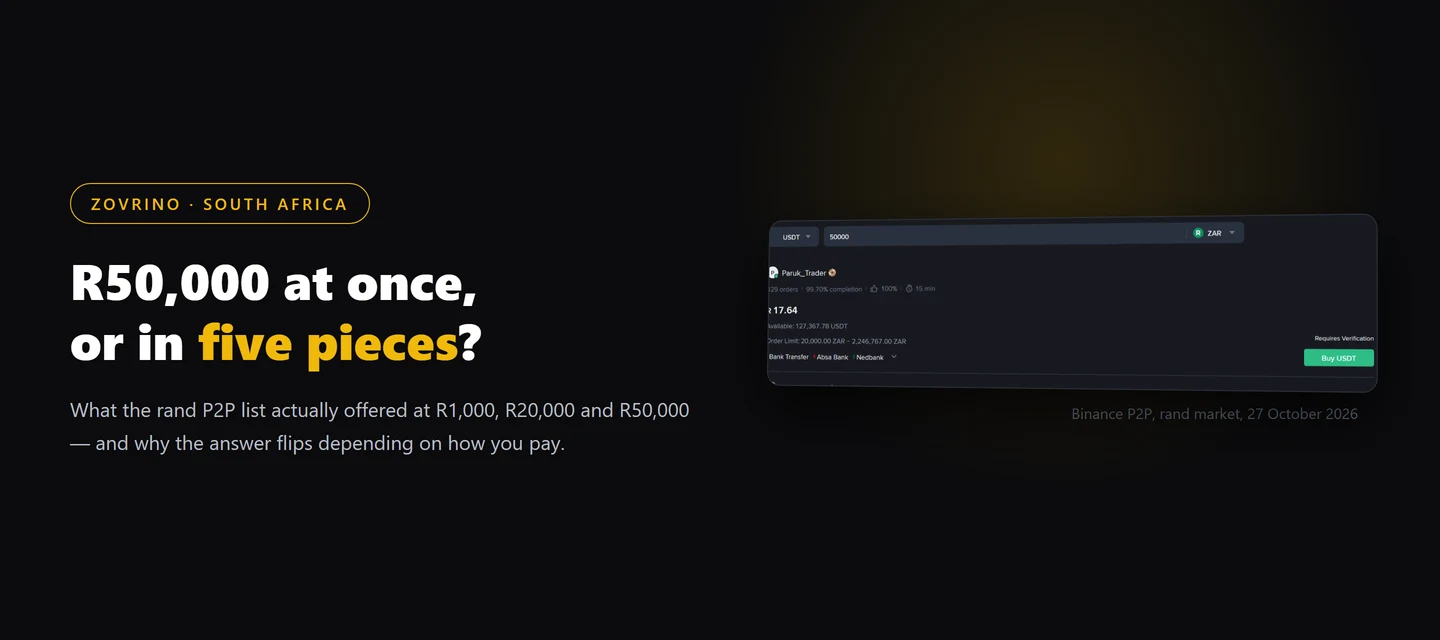
The rand P2P list looks identical whether you are buying R500 or R50,000 of USDT, so the question of how to break up a large first deposit usually gets answered by instinct. Smaller orders feel safer, so people place five of them.
Typing each amount into the public Binance P2P list for USDT against the rand on 27 October 2026 shows that the list does change with the order size — but not in the direction most people expect, and the useful answer depends on whether you are paying by bank transfer or by cash deposit.
The list gets shorter as the order gets bigger
The "Transaction amount" box at the top of the P2P screen is not a calculator. It is a filter: type R50,000 and the page hides every advertisement that will not take a single order that size. Counting what survived at each amount, within the same two minutes:
| Order size | Advertisements offered | Best price |
|---|---|---|
| R1,000 | 16 | R17.32 |
| R5,000 | 20 | R17.32 |
| R10,000 | 19 | R17.32 |
| R20,000 | 16 | R17.32 |
| R25,000 | 14 | R17.64 |
| R50,000 | 13 | R17.64 |
| R100,000 | 4 | R17.64 |
| R200,000 | 2 | R17.64 |
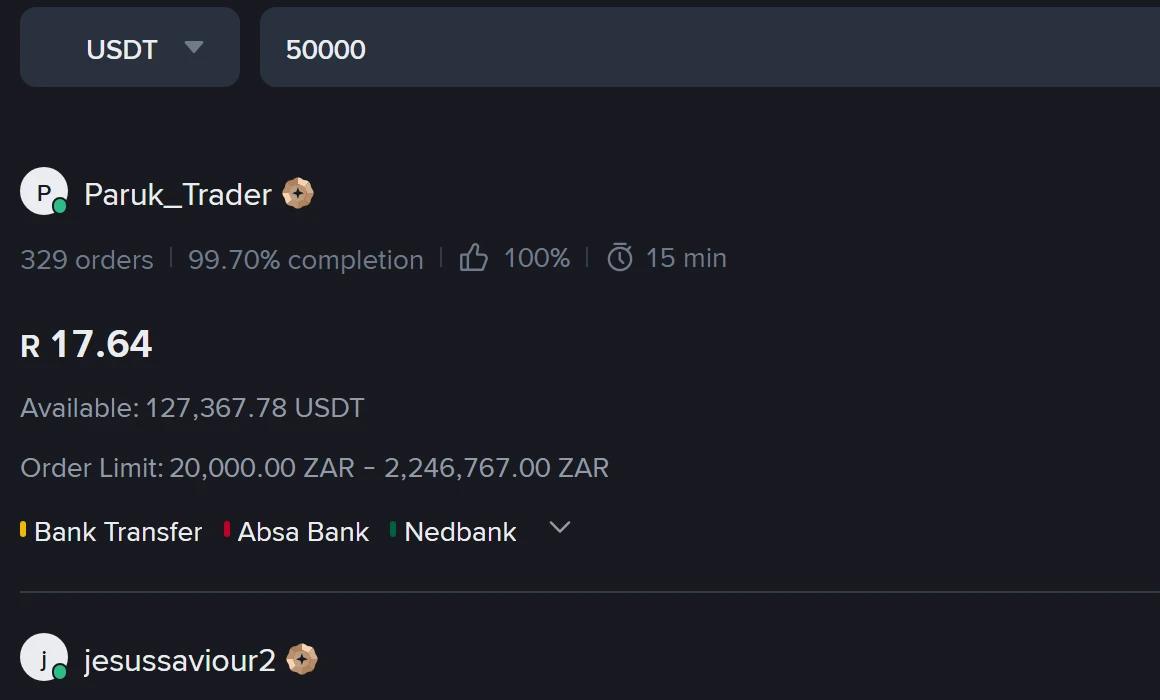
Binance P2P, USDT against the rand, 27 October 2026. At R50,000 the list is down to thirteen advertisements and the best price on offer is R17.64.
Two things fall out of that table. The choice of counterparty collapses well before the money does — at R100,000 you are picking between four advertisers, and at R200,000 between two. And the price is flat up to R20,000, then steps once.
Why the price steps between R20,000 and R25,000
The step is not a volume penalty. It is one advertisement dropping out.
The cheapest offer in the list, at R17.32, carried an order limit of R3,500 to R20,000 and had 5,486.73 USDT available — roughly R95,000 worth of stock. Ask it for R25,000 in one order and it disappears from the list, because R25,000 is outside its per-order ceiling. What remains is a much larger advertiser at R17.64, with 127,367.78 USDT available and a ceiling of R2,246,767.
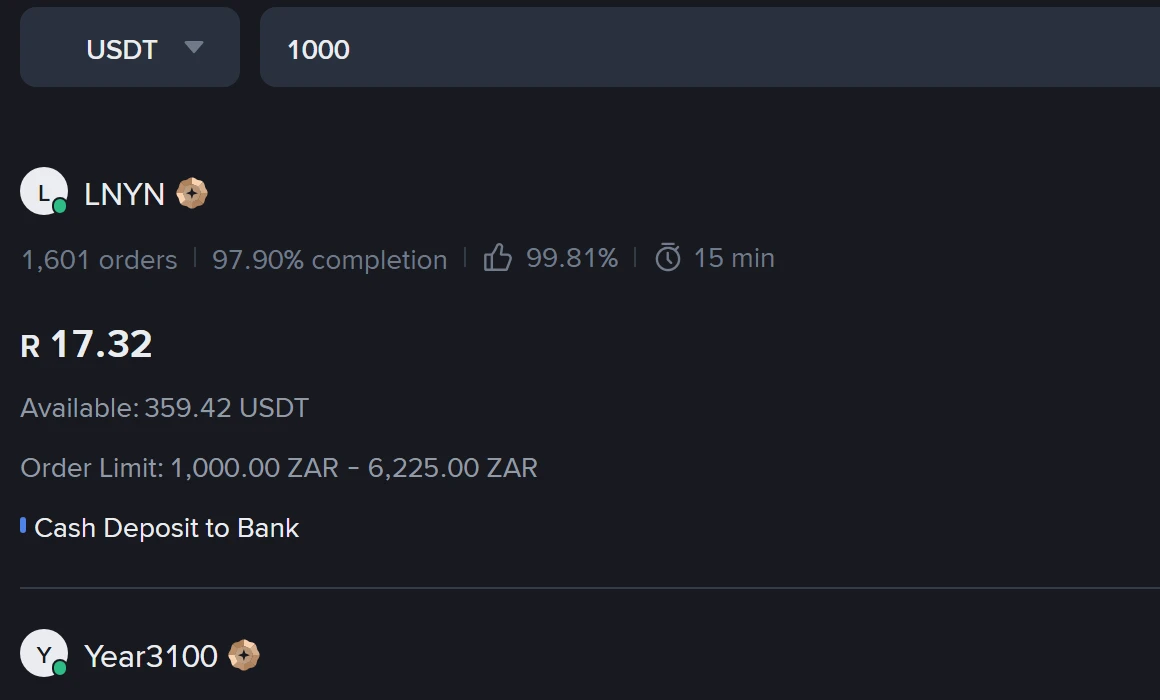
The same list a minute earlier at R1,000. The cheapest price is R17.32 — a second advertisement at the same price, capped at R6,225 — and the only payment method it accepts is a cash deposit at a bank.
That last detail matters more than the price. Both R17.32 advertisements in the list were paid by cash deposit into the seller's bank account, not by EFT. The gap between R17.32 and R17.64 is 1.85%, or about R924 on R50,000 — and South African banks charge a cash-deposit fee per deposit, which appears nowhere on the P2P screen. Before treating R17.32 as the price you pay, look up your own bank's cash-deposit pricing for three deposits of that size. Cash deposits also leave no payer name on the transaction, which is the pattern that causes the most arguments in the three ways a rand P2P trade goes wrong.
If you pay by EFT, one big order was the cheaper one
Filter the same readings down to advertisements that accept a bank transfer, and the pattern reverses:
| Order size | Cheapest bank-transfer price | That advertisement's order limit |
|---|---|---|
| R1,000 | R17.85 | R1,000 – R4,500 |
| R5,000 | R17.69 | R3,500 – R100,000 |
| R10,000 | R17.65 | R10,000 – R22,000,000 |
| R20,000 and up | R17.64 | R20,000 – R9,999,999 |
Priced out on a R50,000 budget, paying by bank transfer every time:
| How you split it | USDT received | Against one order |
|---|---|---|
| One order of R50,000 at R17.64 | 2,834.47 | — |
| Five orders of R10,000 at R17.65 | 2,832.86 | −1.61 |
| Ten orders of R5,000 at R17.69 | 2,826.46 | −8.01 |
| Fifty orders of R1,000 at R17.85 | 2,801.12 | −33.35 |
Splitting into R10,000 pieces cost almost nothing on the day. Splitting into R1,000 pieces cost 33 USDT, about 1.2% — and fifty separate payments. The advertisements that quote the keenest prices to small buyers are small advertisements, and you pay for the privilege of being small.
What splitting costs that the price column does not show
Of the 37 advertisements in the full rand buy list that afternoon, 23 gave the buyer 15 minutes to pay, 13 gave 30 minutes and one gave 45. Every order you open starts its own clock, and the clock does not care that your bank is slow. Five orders means five payments that each have to leave your account and be recognised by the seller inside that window.
Three other things scale with the number of orders rather than the amount:
- Your bank's daily transfer limit. This is set in your own banking app, not by Binance, and a first large payment to an unfamiliar beneficiary is also the kind that triggers a bank's own verification call. Check it before you open an order, not after.
- Availability moves. The R17.32 advertisement above had about R95,000 of stock. Two buyers ahead of you and the price you planned around is gone mid-sequence.
- Each counterparty is a separate risk. Completion rate, order count and payment window are per advertiser; reading a merchant's record before you open an EFT order is work you repeat for every piece you split into.
For large amounts, the comparison worth running is not P2P against P2P
At R1,000 a fixed network fee dominates the arithmetic, which is why the smallest sensible first deposit is a question about floors. At R50,000 fixed fees are rounding errors and the spread is everything — so the route that was never competitive for small amounts becomes the one to beat.
At 13:24 South African time on 27 October 2026, VALR's public order book quoted USDT at R16.7053 on the ask and Luno quoted R16.7068. The best price in the Binance P2P list at that moment, for a R50,000 bank transfer, was R17.64.
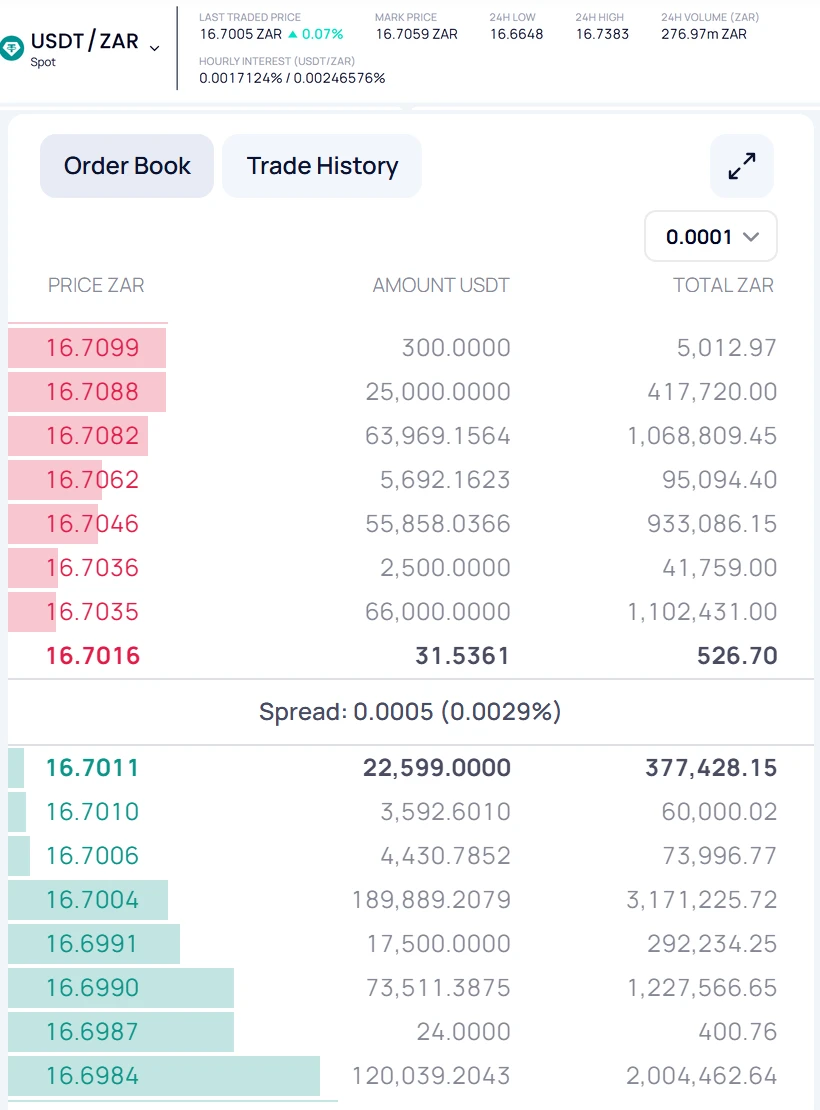
VALR's USDT/ZAR order book is public and needs no login. Read at 13:24 South African time on 27 October 2026.
Run R50,000 through each:
| Route for R50,000 | USDT | Against P2P |
|---|---|---|
| Binance P2P, one order at R17.64 | 2,834.47 | — |
| Binance P2P, cash deposit at R17.32 | 2,886.84 | +52.37 |
| VALR at R16.7053, before its trading fee | 2,993.06 | +158.59 |
A gap of that size does not close on fees. VALR's own published send costs for USDT were 0.50 USDT over Solana, 0.71 over Ethereum and 10 USDT over TRON on the same reading — so the transfer itself costs under R10 if you pick the right network, and twenty times that if you pick the wrong one. Which network to use when you send USDT from VALR or Luno is the step that follows.
Two honest limits on that comparison. Neither VALR nor Luno publishes its trading fee in a machine-readable place, so the figure above is the order-book price before whatever your account pays — check your own fee schedule rather than assuming. And the route is not same-hour the first time: it needs its own FICA verification and a rand deposit that clears before you can trade. The P2P route is slower in rands and faster in days.
Before you move a large amount in
A large first deposit is exactly the shape that trips automated checks, so two rules are worth knowing in advance.
Binance's "T+1" withdrawal hold, which locks part of a P2P purchase against withdrawal for 24 hours, applies to users verified in Egypt, Bahrain and Bangladesh and to five currencies: TWD, EUR, CNY, UAH and KZT. The rand is not on that list.
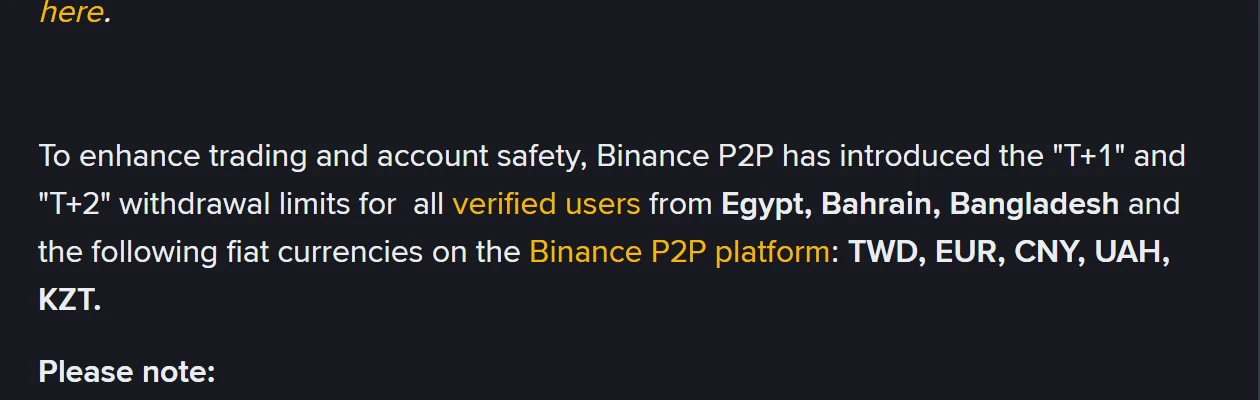
Binance Help Centre, "What Are the 'T+1' and 'T+2' Withdrawal Limits?", read 27 October 2026. The rand does not appear in the list.
The "T+2" limit on the same page is the one to plan around: when Binance's risk control system detects abnormal activity on an account, all withdrawal-related functions are disabled for 48 hours, and the page states the restriction cannot be lifted early. Trading is unaffected; it is withdrawals that stop. If a 48-hour hold on a large balance would be a problem, the answer is not a bigger order — it is a small test order first, and knowing which message matches which cause if one does appear.
If you are going the local-exchange route instead, the transfer out of VALR or Luno asks you for recipient details under the Travel Rule, and what that form actually wants is worth reading before you are holding a large balance on the wrong platform.
So: one order or five?
On the readings above, paying by bank transfer, one order was marginally better than five and clearly better than fifty. Splitting earns you nothing on price and costs you payment windows, counterparty checks and bank-limit friction. It buys exactly one thing worth having: if something goes wrong on the first piece, only that piece is exposed.
That is a real reason to split a first trade with an unfamiliar merchant in two — a small one to see the process through, then the rest. It is not a reason to split R50,000 into fifty.
Sources
- Binance P2P public advertisement list for USDT against the rand, read 27 October 2026 — every advertisement count, price, order limit, available quantity, payment method and payment window quoted above.
- Binance Support, What Are the "T+1" and "T+2" Withdrawal Limits?, stamped as updated 26 May 2026, read 27 October 2026 — the currency list, the merchant exemption and the 48-hour T+2 rule.
- VALR's public USDT/ZAR market and its public currency data, read 27 October 2026 — the order book, and the estimated send costs for USDT over TRON, Ethereum and Solana.
- Luno's public ticker data, read 27 October 2026 — the USDT/ZAR quote.
P2P prices, advertisement counts and order-book quotes move within the hour; every number here is a single reading taken on one afternoon and is meant as a method to repeat, not a price to rely on. This is general information, not financial advice.
If you have not registered yet
Read the Binance referral-code guide first. It covers how to confirm you are on the official domain and how to check that a code has actually applied. Zovrino may receive a commission from an eligible referral; that changes none of the prices or limits described above.
The code we use is CG17CR7R (link). Typing binance.com yourself gives you the same account.