First-Funding Routes
Sending Crypto to Binance from Luno or VALR: What the Travel Rule Asks You
Since 30 April 2025 a South African exchange has to ask who owns the address before it will release a crypto withdrawal. This is what Luno, VALR and Binance each collect, why there is no exemption below R5 000, and what the Financial Intelligence Centre says happens to a transfer when the answers are missing.
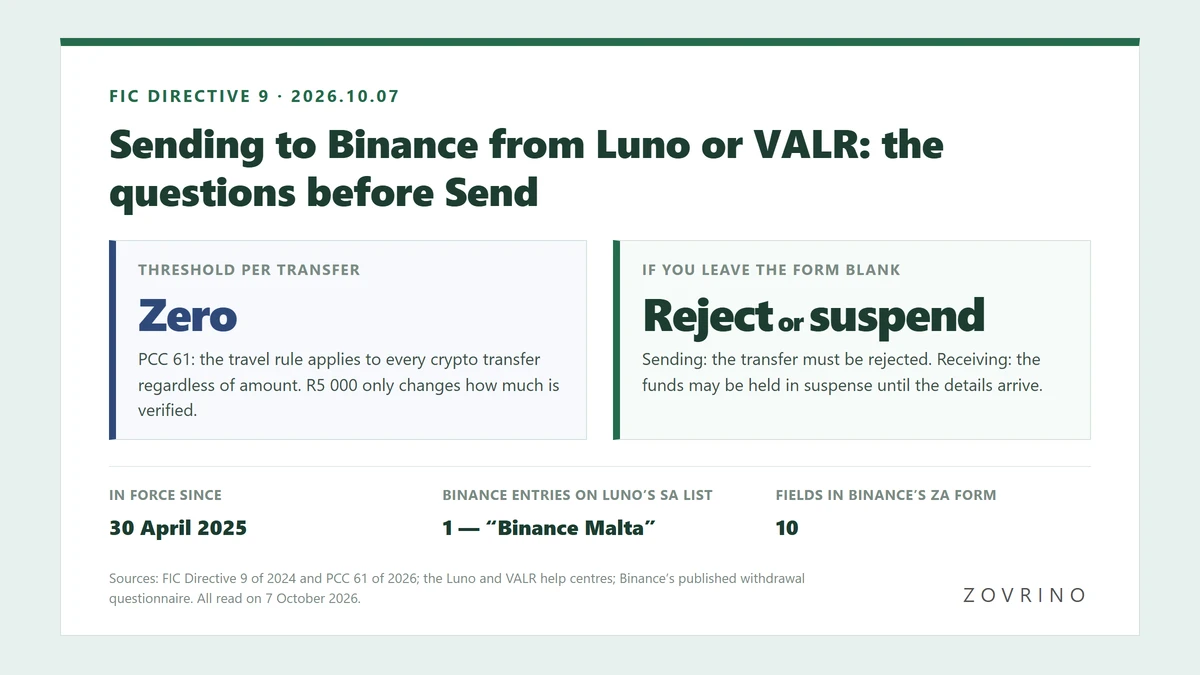
You start a USDT withdrawal on Luno or VALR, paste the deposit address you copied from Binance, and instead of a confirmation screen you get a short form. Does this address belong to you? Is it an exchange or a private wallet? Which exchange? What is the recipient's full name?
None of that was there in 2024. It is South Africa's crypto travel rule, which has applied to every regulated local exchange since 30 April 2025, and answering it carelessly is one of the easiest ways to leave a first deposit sitting in limbo. This guide sets out what the law actually requires, what Luno, VALR and Binance each ask for, and what the regulator says happens to your money if the information is missing.
The rule, in one paragraph
The Financial Intelligence Centre (FIC) issued Directive 9 of 2024 on 15 November 2024, published in Government Gazette 51556 under Notice 5543. It applies to accountable institutions listed in items 12 and 22 of Schedule 1 to the FIC Act — in plain terms, the licensed crypto exchanges operating in or into South Africa. Paragraph 9.1 says the directive "comes into operation on 30 April 2025".
What it requires is simple to state: the exchange sending your crypto must pass certain information about you (the originator) and about the person receiving it (the beneficiary) to the exchange on the other end, before or at the same time as the transfer. Paragraph 7.3 adds that sending the information afterwards "is not permitted". And paragraph 4.8 is the one that bites: an ordering exchange "may not execute a crypto asset transfer if it cannot comply".
That is why the form appears before the Send button, not after.
There is no small-amount exemption
The most common misreading is that transfers under R5 000 are exempt. They are not. The FIC spelled this out in PCC 61, the official guidance it published on 30 March 2026:
"A zero threshold applies per crypto asset transfer for business relationships, this means that all crypto asset transfers regardless of the amount must comply with the travel rule and must have the information as required in terms of Directive 9."
The R5 000 figure does exist in Directive 9, but it changes something narrower — how much of the information has to be verified, not whether it has to travel at all.
A single transaction under R5 000. What still has to travel: your full name, the sending and receiving wallet addresses, your account number or a unique transaction reference, and the beneficiary's full name (Directive 9, para 4.5). What the threshold changes: the sending exchange "need not verify the information … for accuracy, unless there is a suspicion of money laundering or terrorist financing" (para 4.6).
R5 000 and above. The full set applies: your name, your South African ID number — or passport number and date of birth if you are not a citizen or resident — your residential address where it is readily available, plus both wallet addresses and account numbers (paras 4.2 and 4.4). All of it is subject to customer due diligence under the FIC Act (para 4.3).
PCC 61 puts the same point in its own words at paragraph 2.4: transfers below R5 000 "are included in the scope of Directive 9", and the distinction "relates to the customer due diligence verification requirements, and not to the obligation to obtain, hold and transmit the information".
What Luno asks, and the list you are choosing from
Luno's help article Why am I asked these questions when sending or receiving crypto? narrows the scope in its first line: it applies "only if you're verified in South Africa, Malaysia or Indonesia". It then lists what you will be asked:
- Whether the address belongs to you or to someone else — and if it belongs to someone else, details about that person or business.
- Whether the sending or receiving address "is hosted on another exchange or wallet or if it's a private address", with MetaMask, Ledger and Trezor given as examples of private addresses.
- If you are sending to another exchange, which platform — "you'll select the platform from a list if we can't automatically detect where the address is hosted".
Two practical details sit in the same article. First, this is not a per-transaction chore: "You'll only need to provide this information once for each new address you send to or receive from." Second, Luno asks you to get the details right at source — "please make sure that you're getting accurate information directly from the recipient."
The bigger constraint is which destinations are allowed at all. Luno maintains a public list of approved counterparties for South African customers:
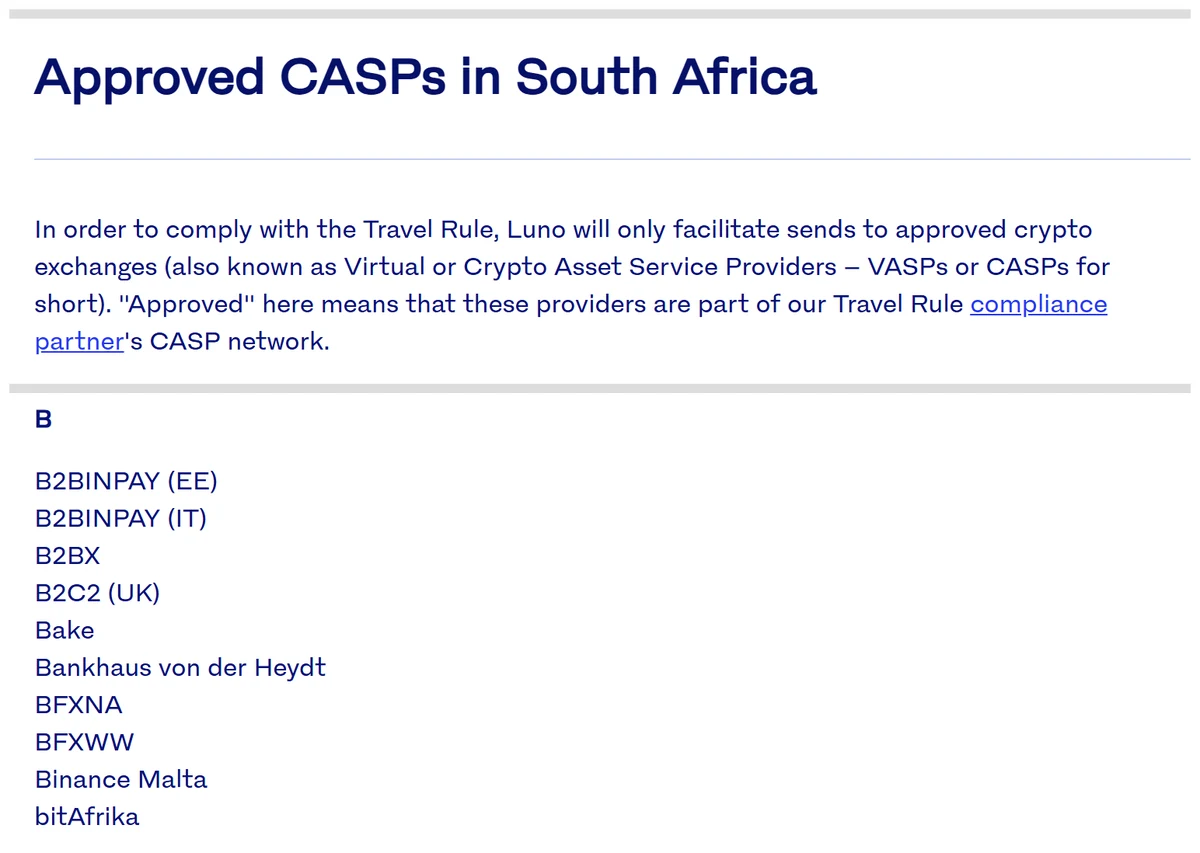
Luno's published list of approved CASPs for South African customers, page last updated 30 January 2026. Captured by Zovrino on 7 October 2026.
Searched in full on 7 October 2026, the word "Binance" appears exactly once on that page, as Binance Malta. There is no separate "Binance" or "Binance.com" entry. Luno also says it "tries" to keep the Help Centre copies up to date and that the in-app list is searchable, so treat the article as a guide and the list inside the app as the authority on the day. If the entry you expect is not there, do not substitute a similar-looking name to get past the screen — the point of that field is to tell the receiving exchange where the funds are coming from.
What VALR asks
VALR's What is the Travel Rule? article sets out its own field list:
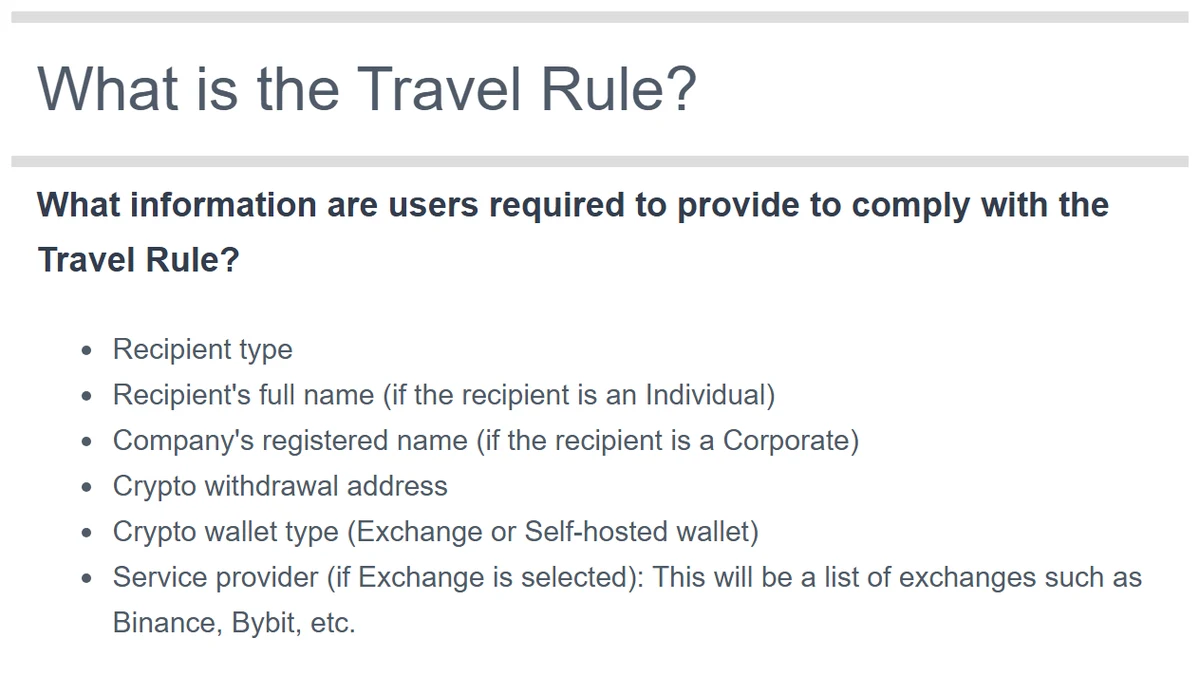
VALR's published Travel Rule requirements, page last updated 6 October 2026. Captured by Zovrino on 7 October 2026.
Four points from VALR's own FAQ are worth knowing before your first send:
- Scope. "All outgoing crypto transactions to non-VALR wallet addresses." There is "no minimum or maximum limit".
- Repetition. You re-enter the recipient details every time "unless you save the information to the Address Book".
- Missing exchange. If the destination is not in the dropdown, you can select "Other" and type the provider's name.
- Your own wallet. Sending to MetaMask or a Ledger is still allowed — "You'll need to indicate that it's a self-hosted wallet during the withdrawal process."
VALR also names its compliance partner (Sumsub) and gives the same 30 April 2025 start date as Directive 9.
What Binance asks on its side
We could not find a South Africa travel-rule article in Binance's help centre, but Binance does publish the underlying data model. Its developer documentation has a page titled Withdraw Questionnaire Contents (for existing local entities), and South Africa is one of the ten entities on it, alongside Japan, Kazakhstan, New Zealand, Bahrain, the UAE, India, the EU (Poland and France), Australia and Brazil:
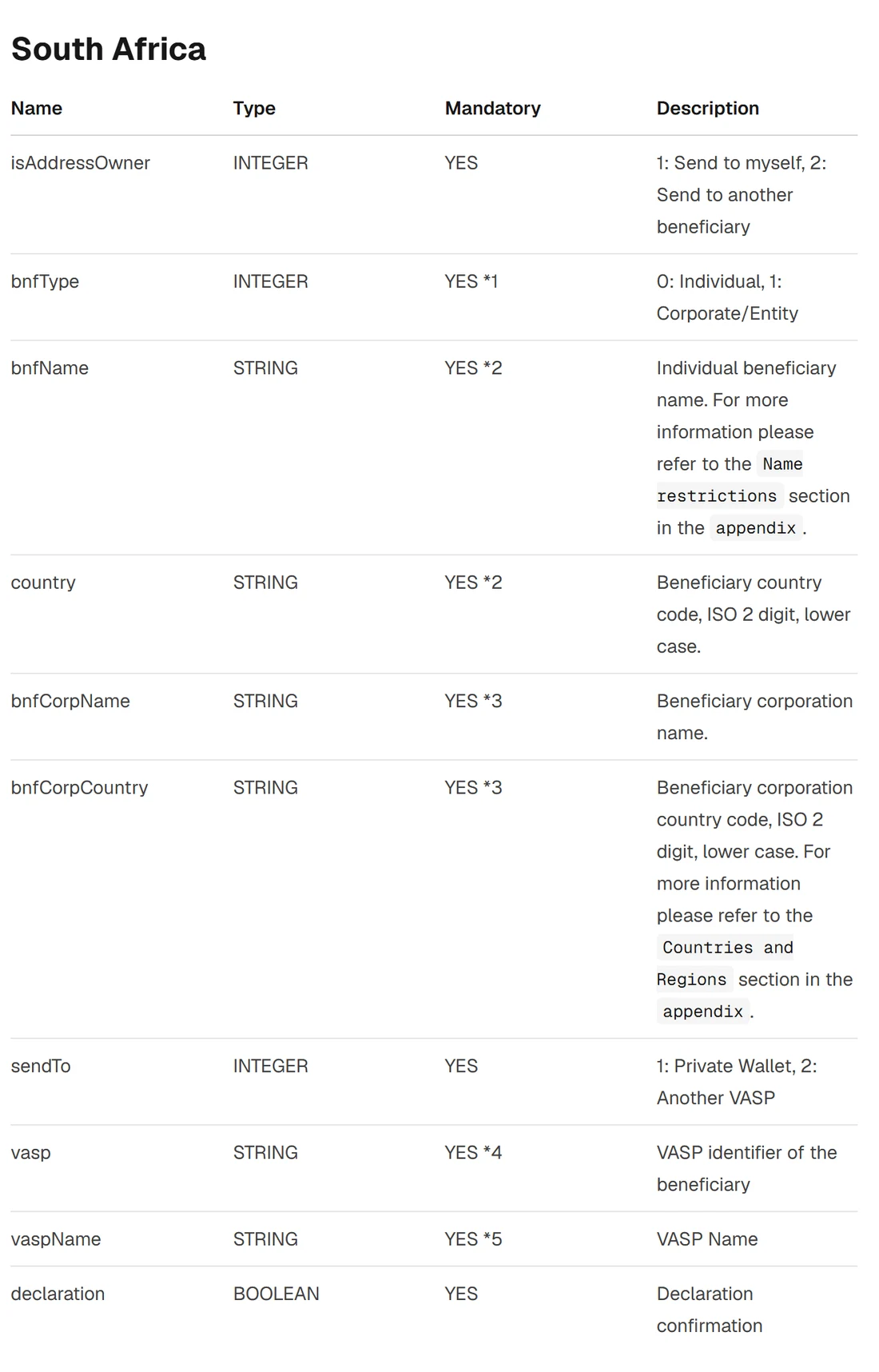
The South Africa section of Binance's public withdrawal questionnaire documentation, read on 7 October 2026.
Read it as a translation key for what the app will ask you:
isAddressOwner— "1: Send to myself, 2: Send to another beneficiary".bnfType,bnfName,country— individual or company, the beneficiary's name, and the beneficiary's country as a two-letter code.sendTo— "1: Private Wallet, 2: Another VASP".vaspandvaspName— which exchange the address belongs to.declaration— a confirmation you tick.
A matching page, Deposit Questionnaire Contents, carries the same structure in reverse for crypto arriving: depositOriginator ("1 = Myself, 2 = Not myself"), receiveFrom ("1 = Private Wallet, 2 = Another VASP"), and the originator's name and country. One difference is worth noting if you compare the two pages: the deposit list covers nine entities and leaves out New Zealand, while the withdrawal list covers ten. South Africa is on both.
These are developer docs, so the wording on the website and in the app will not match character for character. The facts Binance has to collect are the same either way.
What happens if you skip it
This is where the guidance stops being abstract. PCC 61 sets out what an exchange may do when a customer does not provide travel-rule information:
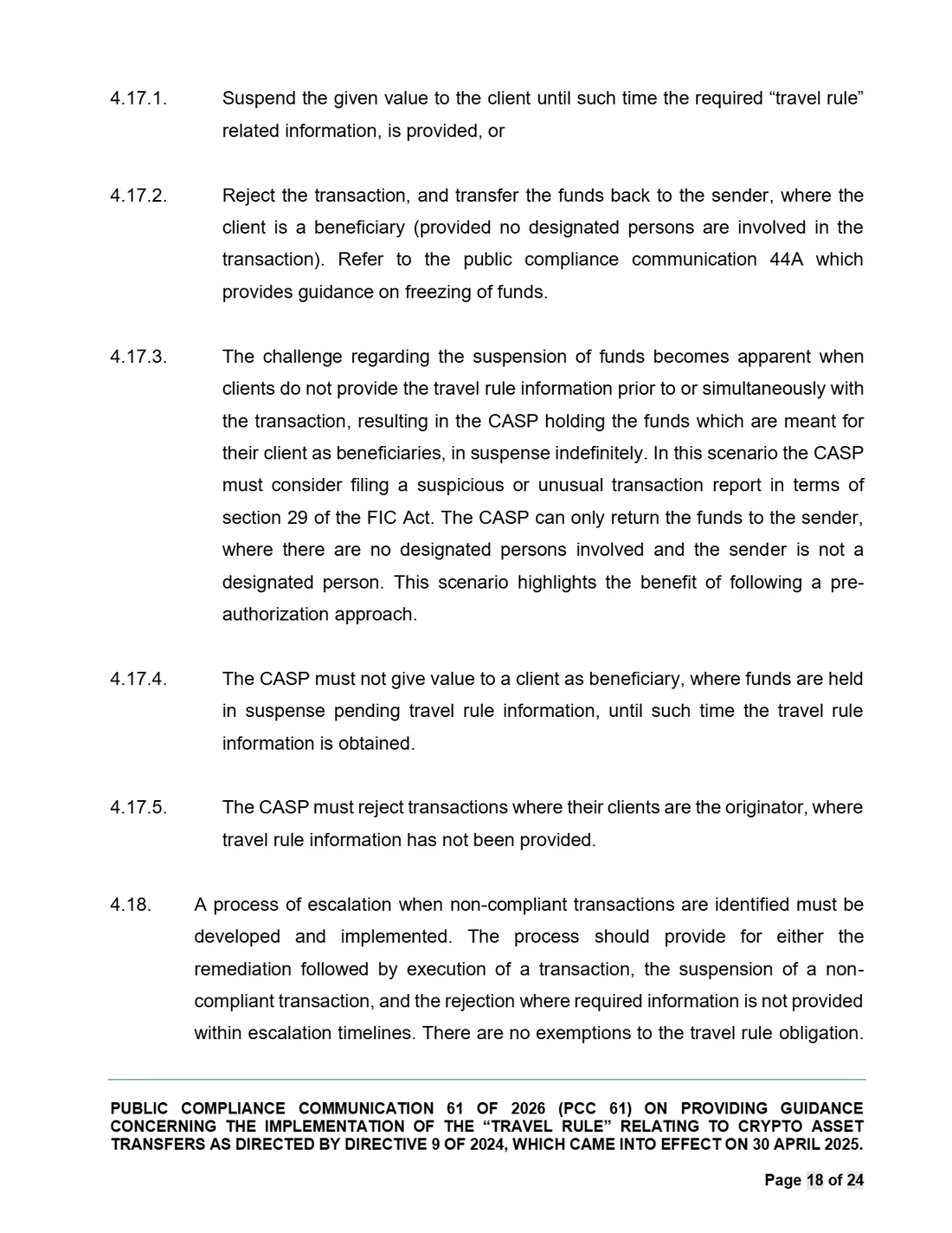
PCC 61 of 2026, page 18, published by the Financial Intelligence Centre on 30 March 2026.
In practice that splits into two very different experiences:
- You are sending. Paragraph 4.17.5 is blunt: the exchange "must reject transactions where their clients are the originator, where travel rule information has not been provided". A rejected withdrawal is irritating but clean — the crypto stays in your account.
- You are receiving. Paragraph 4.17.4 says the exchange "must not give value to a client as beneficiary, where funds are held in suspense pending travel rule information". Paragraph 4.17.3 describes the situation people panic about: funds held "in suspense indefinitely", with the exchange considering a suspicious or unusual transaction report. Returning the money to the sender is only possible in limited circumstances.
Paragraph 4.18 closes the door on negotiating: "There are no exemptions to the travel rule obligation." Directive 9 paragraph 9.2 backs that with an administrative sanction under section 45C of the FIC Act — so an exchange that waves you through is risking a penalty, not doing you a favour.
Two timing rules explain holds that have nothing to do with you personally. If assets have to be frozen because of a sanctions match, PCC 61 paragraph 4.14 requires it "immediately, without delay (which is interpreted by the FATF Methodology to be within twenty-four hours)". If the FIC issues a directive under section 34 of the FIC Act, paragraph 4.15 requires a freeze "for a period of 10 working days".
Five checks before you press send
- Send to yourself, and say so. The cleanest first deposit runs from your own Luno or VALR account to your own Binance account. Both sides then hold the same name, and "send to myself" is the honest answer.
- Check that the spelling matches your Binance verification. PCC 61 paragraph 3.12.7 lists a mismatch between the beneficiary name received and the receiving exchange's own records as a trigger for enhanced due diligence. A middle name on one side and not the other is enough to create one.
- Do not send into someone else's account to save a step. That makes you the originator and them the beneficiary, so you must supply their full name and country, and the receiving exchange will compare it against the account holder.
- Pick the wallet type that is true. An exchange address declared as a private wallet, or the reverse, is exactly what monitoring systems are built to flag.
- Decide the network before the form, not during it. Travel-rule questions do not change network fees, and the gap between chains is larger than most people expect — we priced the Luno and VALR routes into Binance chain by chain.
What the travel rule is not
It is not a tax measure. PCC 61 paragraph 2.5 also draws a clear boundary: "Directive 9 does not apply to fiat currency transfers" — so an ordinary EFT from your bank into a local exchange falls under different rules, not this one.
It is also not evidence that a platform is regulated here. Appearing on an approved-counterparty list is an arrangement between exchanges and their compliance vendors; whether a provider is licensed in South Africa is a separate question you can answer yourself on the FSCA's own register.
And answering the questionnaire does not confirm the money arrived. If a transfer shows as complete on the sending side and still is not visible in your Binance wallet, work through the four checks for a deposit that has not appeared before you contact support.
Sources and dates
- FIC Directive 9 of 2024 — Travel rule relating to crypto asset transfers (PDF, 9 pages; Government Gazette 51556, Notice 5543, 15 November 2024). Paragraphs cited: 4.2, 4.3, 4.4, 4.5, 4.6, 4.8, 7.3, 9.1, 9.2. Downloaded 7 October 2026.
- FIC Public Compliance Communication 61 of 2026 (PDF, 24 pages; issued 30 March 2026). Paragraphs cited: 2.4, 2.5, 3.1, 3.12.7, 4.14, 4.15, 4.17, 4.18. Downloaded 7 October 2026.
- Joint advisory by the FIC and the FSCA, 17 April 2025 (PDF) — confirms the 30 April 2025 start date and states that the two authorities "do not have the authority to provide exemptions from the strict requirements of Directive 9".
- Luno: Why am I asked these questions when sending or receiving crypto? — page last updated 23 September 2026, read 7 October 2026.
- Luno: Approved CASPs in South Africa — page last updated 30 January 2026, read 7 October 2026.
- VALR: What is the Travel Rule? — page last updated 6 October 2026, read 7 October 2026.
- Binance Developer Docs: Withdraw Questionnaire Contents and Deposit Questionnaire Contents — read 7 October 2026.
Help-centre pages and approved-counterparty lists change without notice, and the screens inside each app are updated more often than the articles describing them. Everything above is a reading taken on one day. This is general information about a regulatory requirement, not legal or financial advice.
If you have not registered yet
Read the Binance referral-code guide first. It explains how to verify the official domain, the code CG17CR7R and the advertised benefit of up to 20% in trading-fee rebates. Eligibility, products and the final rate depend on the registration page and account terms; Zovrino may receive a commission from an eligible referral. A referral link changes nothing about the travel-rule questions described above.
The code we use is CG17CR7R (link). Typing binance.com yourself gives you the same account.