P2P Safety
Binance P2P Scams in South Africa: Fake Proof of Payment, Third-Party Payers and WhatsApp Deals
Forged payment screenshots, money sent from a stranger’s account and deals arranged on WhatsApp are the three ways a rand P2P trade usually goes wrong. Binance’s own policy says who carries the loss in each case, and on 21 October 2026 the payment methods that hide the payer’s name sat mostly on the side where you would be the seller.
Most Binance P2P trades in rand finish without drama. The ones that go wrong almost always go wrong in the same few ways, and every one of them turns on a detail you can check on the order screen before you click anything: who the money came from, whether it is actually in your bank account, and whether the conversation is happening inside the order.
This walks through the patterns Binance itself documents, the rule in its P2P policy that decides who carries the loss, and what the live rand market looked like on 21 October 2026.
A screenshot is not a payment
The oldest trick on the selling side is a forged proof of payment. Binance's help page on P2P scams puts it plainly: scammers can digitally manipulate screenshots, claim they have paid, and then pressure you into releasing the crypto. The same page lists a variant where the "bank notification" arrives as an SMS designed to look like your bank's.
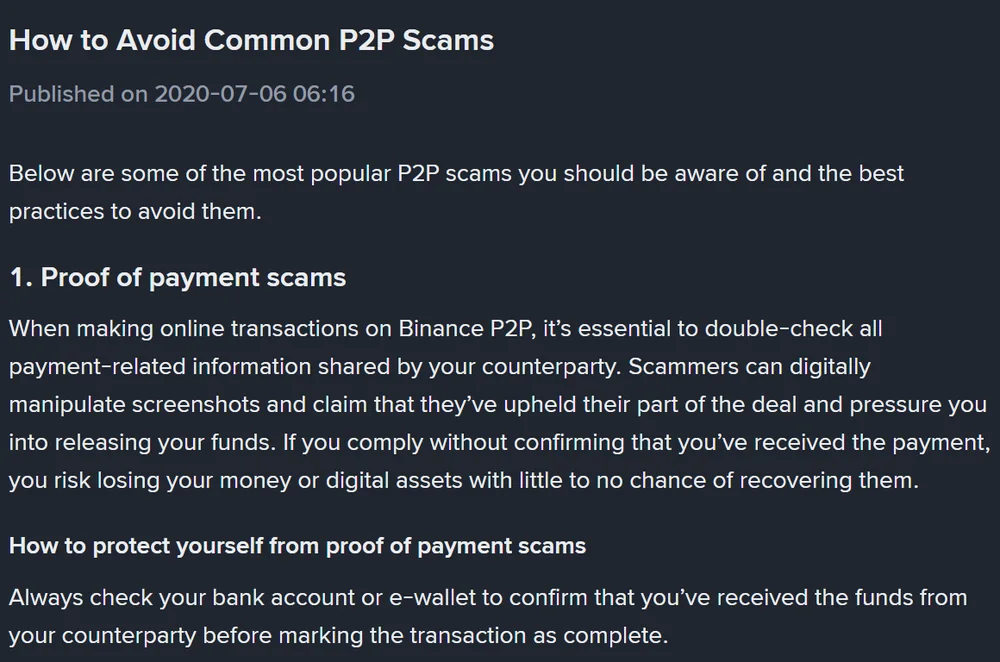
Binance Help Centre, "How to Avoid Common P2P Scams", read 21 October 2026.
Binance's own advice is the whole defence: open your banking app or internet banking and confirm the money has arrived, from the right account, for the right amount. Not the SMS, not the PDF, not the screenshot in the chat — the balance.
Two things make this harder in South Africa than it sounds. An ordinary inter-bank EFT can show as sent on the payer's side long before it reflects on yours, while a real-time payment lands in seconds; the order timer does not distinguish between the two. And once you have released, Binance's position is that the platform is not a party to the trade. There is no reversal button.
Note the mirror-image rule for buyers. The policy says you must not tap "Transferred, notify seller" before the payment is actually made, and that your account may be suspended if you do.
The name on the paying account has to be yours
The second pattern is money that arrives from somebody else's account — a friend, an employer, a "payment agent", or a stranger whose own account is already under investigation. It looks like a solved problem: the money is there. It is not.
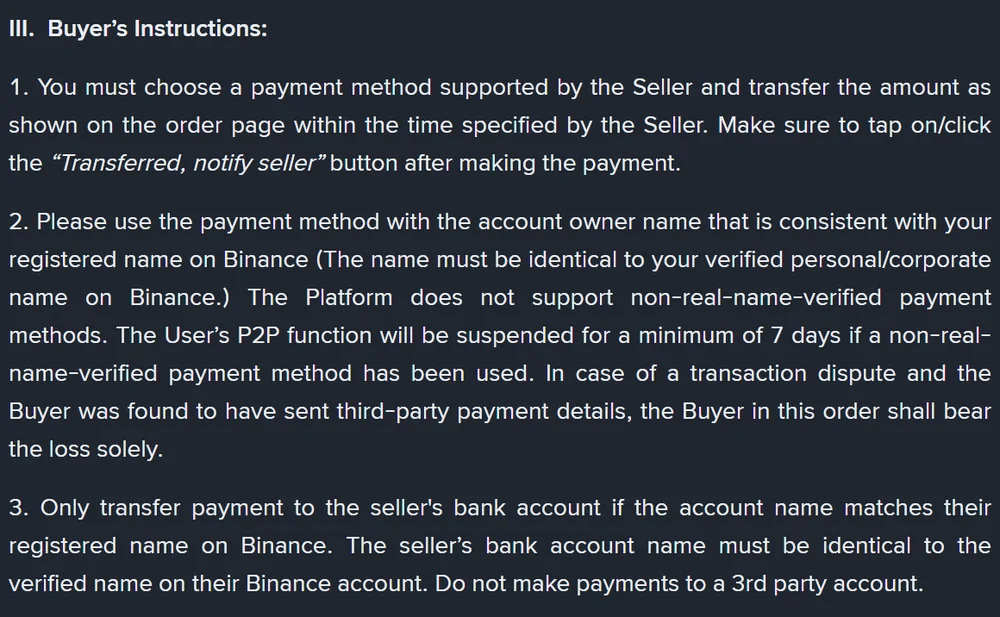
Binance P2P User Transaction Policy, clauses III.1 to III.3, updated 12 May 2026, read 21 October 2026.
The Binance P2P User Transaction Policy is unusually specific here. Buyers must pay from an account in the name verified on their Binance account; the platform does not support payment methods that are not real-name verified, and using one suspends P2P access for a minimum of seven days. If a dispute follows and the buyer sent third-party payment details, the policy says that buyer "shall bear the loss solely". The equivalent clause under Seller's Instructions applies the identical rule to sellers who hand over someone else's banking details.
So if a third-party payment lands in your account, the scam-prevention page tells you what to do rather than what to fear: do not release, file an appeal, and refund the payment to the account it came from.
The general trading section adds the quiet part. Binance discourages payment methods that do not show the payer's name to the seller, and says that where a dispute arises from such a method, the buyer is responsible for the loss. That clause is the reason the next section matters.
Where the nameless payment methods cluster
On 21 October 2026 the public rand advertisement list carried 101 sell advertisements — the side you use when you are buying USDT — and 43 buy advertisements, the side you use when you are selling. Counting how often each payment method appears:
| Payment method | Ads where you buy (101) | Ads where you sell (43) |
|---|---|---|
| Bank Transfer | 90 | 24 |
| FNB | 58 | 4 |
| Absa | 54 | 12 |
| Nedbank | 52 | 12 |
| Capitec | 49 | 9 |
| Cash Deposit to Bank | 5 | 10 |
| FNB eWallet | 4 | 12 |
Cash deposits appear on 5% of the advertisements where you would be the buyer, and on 23% of the ones where you would be the seller. An advertisement can list several methods, and the list changes through the day, so treat this as one snapshot rather than a constant.
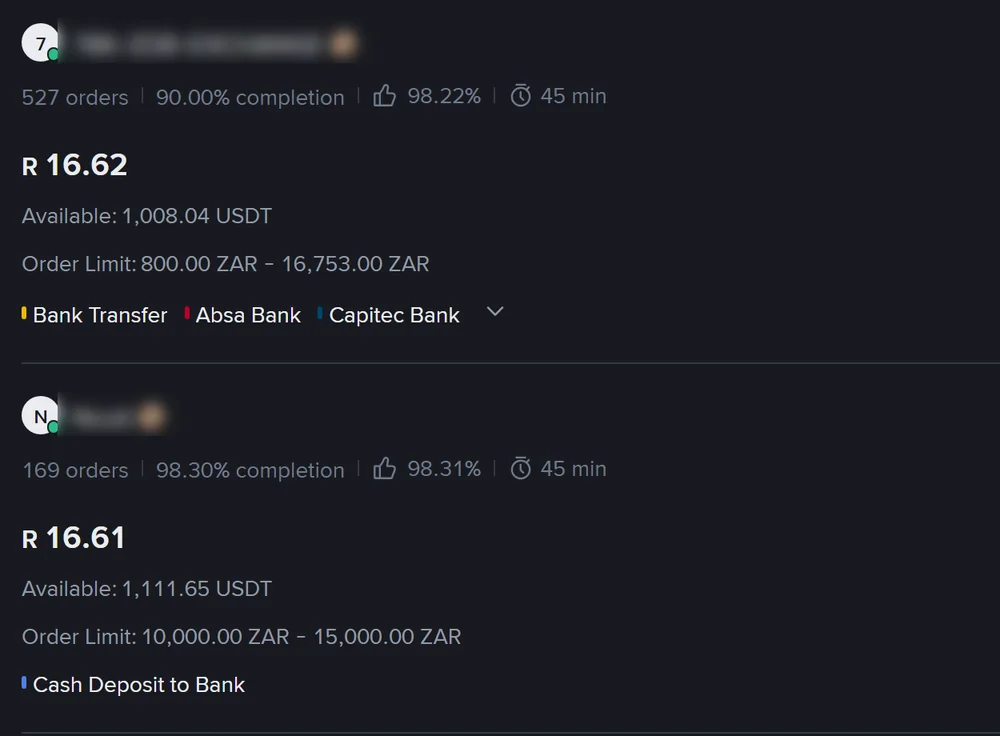
Two consecutive advertisements in the Binance P2P rand market, "Sell USDT" view, 21 October 2026. Advertiser names blurred; no advertiser shown here is recommended.
A cash deposit into your account does not carry a verified payer name, which is exactly the situation that clause describes — and it is also the kind of deposit that draws a bank's attention. Binance's page on frozen bank accounts is about this: sellers have had accounts frozen after trading with buyers whose funds turned out to be proceeds of a scam. Its suggestions are practical — ask for additional identity confirmation in the order chat before proceeding, keep P2P trading in a separate bank account, do not run several trades at once, and keep crypto words out of the payment reference. If you are weighing routes anyway, our comparison of the three ways to turn USDT back into rand prices the alternatives to P2P.
The deal that starts on WhatsApp
The third pattern is the one appeals cannot fix. Binance describes it as the man-in-the-middle scam: someone posing as a reputable merchant contacts you on Telegram, WhatsApp or social media, sends you "their" banking details and a link to a P2P advertisement, and asks you to confirm the details by pasting them into the order chat. The order you are actually in belongs to an unrelated buyer, who then pays the scammer's account while you release crypto to them.
Binance's conclusion is blunt: because all communication with the fraudster happened outside the platform, and the funds went to a third-party account, there is little customer service can do. The policy backs this up — it says you should never trade through a third-party channel such as social media, chat apps or face-to-face, because the platform cannot be responsible for anything initiated outside it.
The related trap is someone in the order chat claiming to be Binance support, telling you the money is "with Binance" and you need to release first, or send an internal transfer. Binance states it will never email you asking to complete a P2P transaction. Customer support does not join your order chat to vouch for a counterparty.
There is also a two-order version, which Binance calls the triangle scam: two orders opened with the same seller at once, one real payment, and the proof of that payment re-used to push the second release through. The defence is the same as for the first pattern — match each payment to each order in your bank statement, not to the screenshot in front of you.
Before you open the order, and after it goes wrong
Before: check the advertisement properly. Reading order count, completion rate, limits and written terms together is a separate job, and we covered it in how to pick a rand EFT merchant on Binance P2P.
During: keep every message in the order chat. The policy also asks you not to put phone numbers, social accounts or other personal details in the chat or in your trading terms.
After: if you have paid and the seller has gone quiet, the appeal route and the evidence it needs are set out in what to do when a seller has not released your USDT. If you are the seller and a third-party payment has landed, appeal first and refund to the sending account rather than releasing. If your bank account has been frozen, Binance's guidance is to contact the bank immediately, cooperate with the authorities with your order records in hand, and get legal advice if it goes further.
One rule covers almost all of it. The seller's obligation under the policy is to release within 15 minutes of confirming receipt of full payment — confirming, not being told.
Sources
- Binance Support, How to Avoid Common P2P Scams, page stamped "Published on 2020-07-06" with no update date, read 21 October 2026 — proof of payment, SMS, chargeback, man-in-the-middle, triangle and imposter patterns, and the protective steps quoted here.
- Binance Support, Binance P2P User Transaction Policy, stamped "Updated on 2026-05-12", read 21 October 2026 — the general trading instructions, the Buyer's Instructions and the Seller's Instructions quoted above.
- Binance Support, How to Prevent My Bank Account from Being Frozen in P2P Transactions, read 21 October 2026 — the frozen-account precautions and what to do if it happens.
- Binance P2P public advertisement list for USDT against the rand, counted on 21 October 2026 — the 101 sell and 43 buy advertisements and the payment-method counts in the table.
Binance edits these pages without notice and one of them is six years old, so the quotations above are a reading taken on a single day. Advertisement counts move hour by hour. This is general information about P2P trading risk, not financial or legal advice.
If you have not registered yet
Read the Binance referral-code guide first. It explains how to confirm the official domain, the code CG17CR7R and the advertised benefit of up to 20% in trading-fee rebates. Eligibility, products and the final rate depend on the registration page and account terms; Zovrino may receive a commission from an eligible referral. A referral link changes none of the P2P rules described above.
The code we use is CG17CR7R (link). Typing binance.com yourself gives you the same account.