First-Funding Routes
Deposit ZAR to Binance: P2P, Card or Crypto?
Clarifies the difference between a direct ZAR fiat deposit and paying a P2P seller by EFT, then compares card and crypto-transfer routes by total cost and failure risk.
A bank transfer shown on Binance P2P is not automatically a direct ZAR deposit into a Binance bank account. On P2P, you normally pay another verified user or merchant by EFT while Binance holds the crypto in escrow. A direct fiat deposit is a separate product and only exists when your logged-in Fiat Deposit screen offers ZAR and gives you deposit instructions.
That distinction matters. Search results often use “bank transfer to Binance” for two different flows, which leaves a new user unsure about who receives the money and where to look when a payment does not arrive.
This guide was checked on 11 August 2026. Routes vary by account, location, payment provider and time. Treat the options shown inside your verified account as the current source of truth.
Four routes that look similar at first
Direct fiat deposit
- Who receives the money or asset?: The bank details supplied in the Fiat Deposit flow
- What reaches Binance?: A fiat balance or purchase route described on screen
- Main risk to check: Assuming ZAR is supported because another currency is shown
P2P with bank transfer
- Who receives the money or asset?: A P2P counterparty, paid by EFT under an active order
- What reaches Binance?: Crypto released from escrow, usually into the Funding wallet
- Main risk to check: Paying the wrong name, going off-platform, or missing the timer
Card purchase
- Who receives the money or asset?: A card payment processor
- What reaches Binance?: The quoted crypto amount
- Main risk to check: Decline, foreign-card charges, spread, or expired quote
Crypto deposit
- Who receives the money or asset?: A Binance blockchain address
- What reaches Binance?: The same supported token on the selected network
- Main risk to check: Wrong network, missing memo, low amount, or delayed confirmations
The first question is therefore not “Does Binance accept bank transfer?” Ask: “Is this a direct fiat deposit, or am I paying a P2P counterparty by bank transfer?”
What the public ZAR P2P page showed
When Zovrino opened Binance’s public South African P2P page on 11 August 2026, the market displayed USDT offers priced in ZAR. Several advertisements listed Bank Transfer or named South African banks as payment methods. The page also marked the trades as requiring verification.
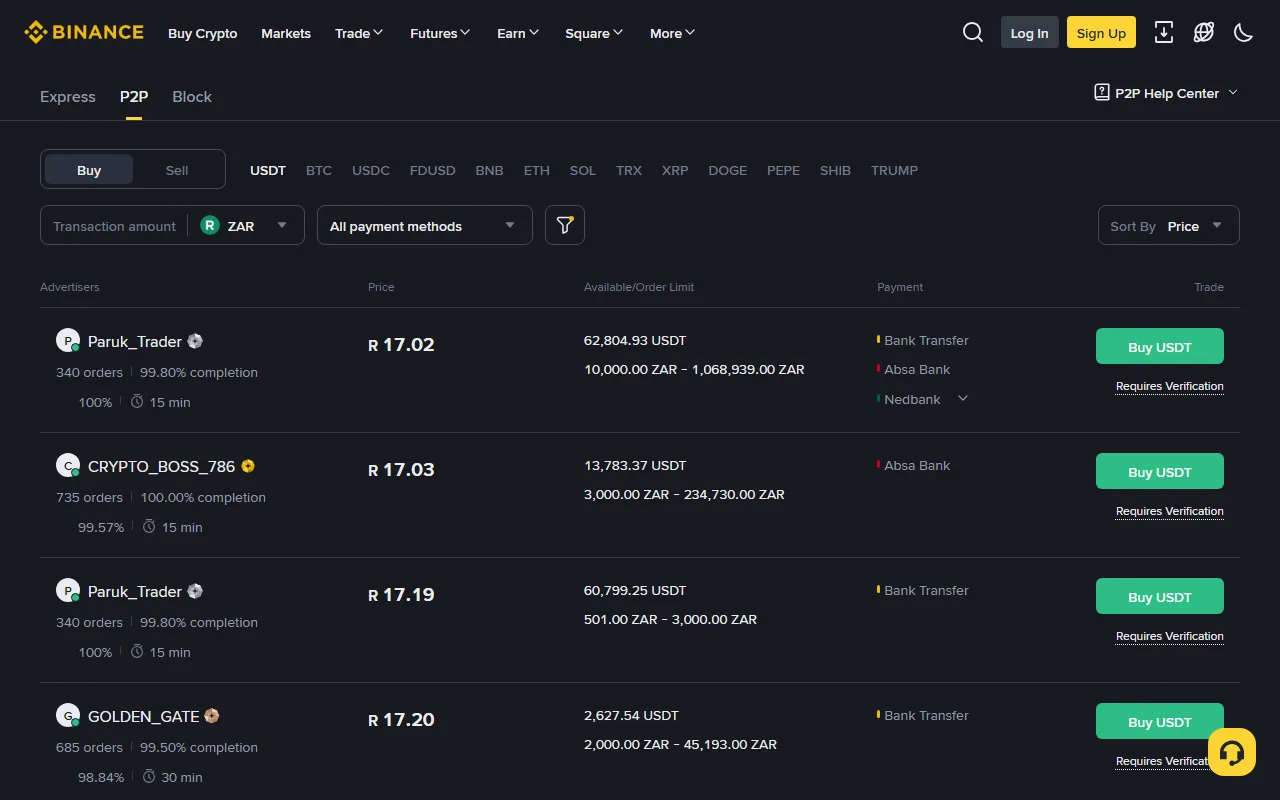
Screenshot: Binance public P2P market, USDT/ZAR, captured by Zovrino on 11 August 2026. Advertisements and prices change; the image is evidence of the interface at capture time, not a merchant endorsement or a current quote.
This page supports a narrower conclusion than many reviews make: a ZAR-denominated P2P market was publicly visible at the time of checking. It does not prove that every South African account can make a direct ZAR fiat deposit, that every listed bank will process a transfer, or that a specific offer will still exist when you register.
How to tell whether a direct ZAR deposit is actually available
After identity verification, open Deposit and choose Fiat Deposit. Search for ZAR. If Binance offers a direct route, the screen should identify the currency, provider, fee, limits, expected processing time and bank instructions before you send money.
Stop if any of these details are missing. Do not copy bank details from a blog post, video comment, message or old screenshot. Payment providers and account numbers can change. A genuine deposit route must be generated inside your current Binance session.
If ZAR is absent but a Bank Transfer label appears on P2P, you are looking at the second route: an EFT to a counterparty under a P2P order.
How a P2P bank payment works
Choose the fiat currency and crypto, enter the amount, then filter offers by payment method. Before opening an order, check:
- the advertiser’s completed-order history and completion rate;
- the minimum and maximum order amount;
- the ZAR price per unit and the amount of USDT you will receive;
- the accepted banks and any written payment conditions;
- the payment window.
Once an order is open, use only the recipient details displayed in that order. The name on the bank account should match the verified counterparty details shown by the platform. Pay from a bank account in your own verified name. Do not accept a request to cancel the order and continue on WhatsApp or Telegram.
Mark the order as paid only after your bank confirms the transfer. If the seller does not release the crypto, keep the order open and use the appeal process. Save the bank confirmation, order number and in-platform chat. A screenshot of a draft payment is not proof that the bank completed it.
When a card may be simpler
A card purchase removes the P2P counterparty, but it does not remove cost. The useful number is the effective ZAR cost per unit of crypto:
Effective ZAR cost = final card charge ÷ crypto actually received
Check the final confirmation screen, not the first promotional estimate. Your bank may add a cross-border or card-processing charge after the merchant quote. The card may also be declined even when ordinary online purchases work, because the issuer or payment processor applies separate rules to crypto transactions.
If a payment fails, avoid repeated attempts in quick succession. First check whether the bank recorded a completed charge, a pending authorisation or no transaction. These states need different responses. A pending authorisation can disappear without becoming a completed purchase.
Depositing crypto from another exchange or wallet
This route is useful when you already own crypto elsewhere. It is not a shortcut for someone who has never bought crypto, because you still need an on-ramp at the sending platform.
Open Binance’s Crypto Deposit screen, choose the asset and network, then copy the address. The sending platform must use the same asset and network. If the deposit screen shows a memo or tag, include it.
Before confirming, check the withdrawal fee, Binance’s minimum deposit, and whether the receiving network is temporarily suspended. For a new address, a small test can reduce the impact of a mistake, but it must still exceed all minimums and be large enough that a fixed withdrawal fee does not consume an unreasonable share.
Compare the routes with one cost formula
Claims such as “zero deposit fee” are incomplete because they ignore the exchange rate and spread. Use this calculation for every route:
Effective ZAR per USDT = all ZAR paid ÷ final usable USDT
For P2P, use the order payment and the amount released. For a card, use the final card charge and actual receipt. For a crypto transfer, include the cost of buying the asset at the sending exchange and subtract trading and withdrawal fees from the amount that reaches Binance.
Then add two non-price columns: expected time and recovery path. A slightly cheaper route may be a poor first choice if you do not understand how to appeal, trace a transaction ID or contact the payment provider.
A practical first-deposit decision
Use P2P when you understand the order flow, can pay from an account in your own name and find a suitable offer. Use a card when the final quote is acceptable and your bank permits the transaction. Use a crypto deposit when you already hold the asset and can verify the network details. Use a direct fiat deposit only when your logged-in account generates the current instructions.
Before registration, check that Binance serves your location and that the official registration page carries the referral information you intend to use. Referral rewards can depend on eligibility, trading activity, campaign periods and other conditions. A maximum headline is not a guaranteed payment for opening an account.
Check the referral code before registering
Read the Binance referral-code guide. It explains how to verify the official domain, code CG17CR7R and the advertised benefit of up to 20% in trading-fee rebates. Eligibility, products and the final rate depend on the registration page and account terms; Zovrino may receive a commission from an eligible referral.
Under this referral arrangement, an eligible new user can receive a 20% trading-fee discount, subject to Binance’s current regional eligibility, account requirements and referral terms. The final rate, eligible products and duration are the values shown on the registration page or inside the account. A zero-fee trade has no trading fee to discount.
Zovrino may receive a referral commission from qualifying trading activity. Using the link is not investment advice and does not guarantee a reward, profit or product availability in your location.
Related checks before you fund
- Binance South Africa Referral Code: How to Check It Before You Register
- VALR or Luno to Binance: Which Network Makes a Small USDT Transfer Cheaper?
- How Much Does R1,000 Buy on Binance? A Repeatable ZAR Cost Worksheet
- Binance Card Payment Declined in South Africa: Pending Hold, Reversal or Completed Charge?
- Binance P2P South Africa: How to Choose a Merchant Before Paying by EFT
Sources and verification
- Binance Academy: Your Guide to Binance Deposit/Withdrawal
- Binance P2P public market for ZAR
- Binance Referral Program Terms and Conditions
Sources and screenshot checked: 11 August 2026, UTC+8. Zovrino did not log into a personal account or complete a payment for this article.
the official Binance sign-up page (code CG17CR7R). The page states trading cashback of up to 20%; the real rate is whatever it shows for your account and region. We may earn a commission.