Missing Funds and Fixes
Binance Paused Deposits and Withdrawals: What It Means for a First Rand Purchase
Binance suspended crypto deposits and withdrawals on 30 October 2026 after a security incident. Checked at 13:10 SAST, all 1,447 withdrawal channels were closed while most deposits still credited, both rand markets were still trading, and USDT on Binance sat about 1.7% below VALR and Luno.
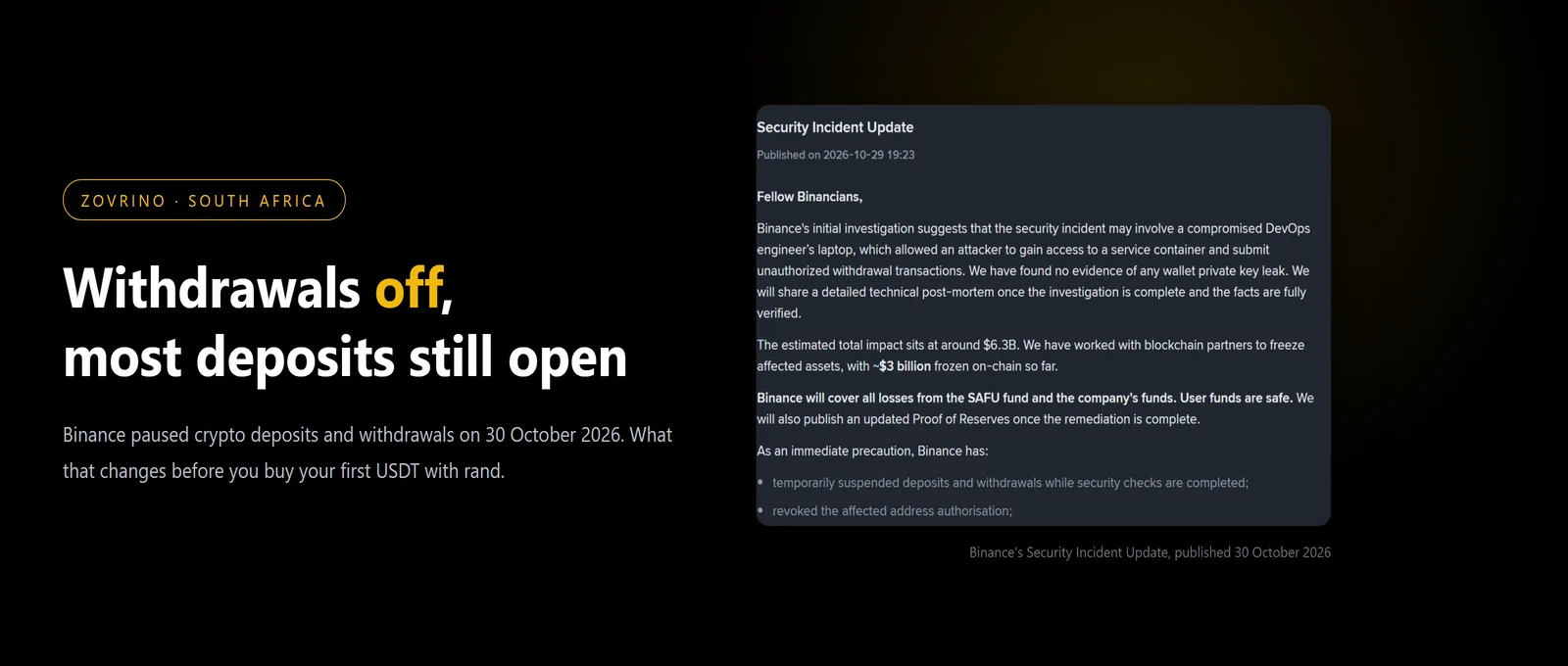
At 04:23 on Thursday morning, South African time, Binance published a notice headed Security Incident Update. Five lines in comes the part that affects anyone with money on the exchange: as an immediate precaution Binance has "temporarily suspended deposits and withdrawals while security checks are completed".
That one sentence does not mean the same thing for money going in as for money coming out. Checked at 13:10 on 30 October 2026, every withdrawal channel on the exchange was closed, while most deposit channels were still open and still crediting. For a first rand purchase that combination is the worst of both worlds, and it is worth understanding before you move anything.
What the notice says, and what it leaves out
The published text is short. Binance's initial investigation "suggests that the security incident may involve a compromised DevOps engineer's laptop, which allowed an attacker to gain access to a service container and submit unauthorized withdrawal transactions", and the company says it has "found no evidence of any wallet private key leak". The estimated total impact "sits at around $6.3B", with "~$3 billion frozen on-chain so far". Binance states that it "will cover all losses from the SAFU fund and the company's funds" and that user funds are safe, with an updated Proof of Reserves promised once remediation is complete.
Three immediate measures are listed: the suspension of deposits and withdrawals, revoking the affected address authorisation, and engaging law enforcement and blockchain intelligence partners.
What the notice does not contain matters just as much. There is no restart time, no estimate, and no staged plan. There is no mention of P2P, of spot trading, or of any individual country or currency. Anyone telling you on Telegram or WhatsApp that withdrawals reopen at a specific hour is not quoting Binance.
Withdrawals: all of them, not just your coin
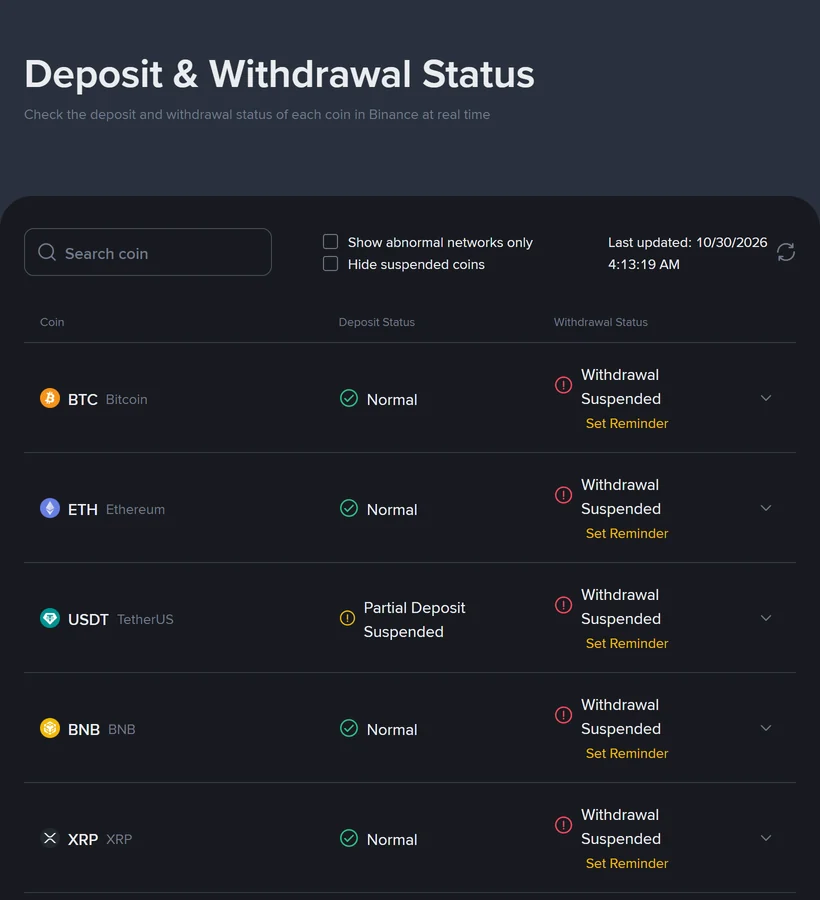
Binance publishes a live status page at binance.com/en/network, and the same data sits behind it for every coin and network. Read at 13:10 South African time, that data covered 990 coins across 1,447 coin-and-network combinations. Withdrawals were disabled on all 1,447 of them. Deposits were disabled on 398 — just over a quarter.
That is the pattern in the screenshot above: Bitcoin, Ethereum, BNB and XRP all sit on "Normal" for deposits and "Withdrawal Suspended" for withdrawals.
"Partial Deposit Suspended" is not a verdict on your network
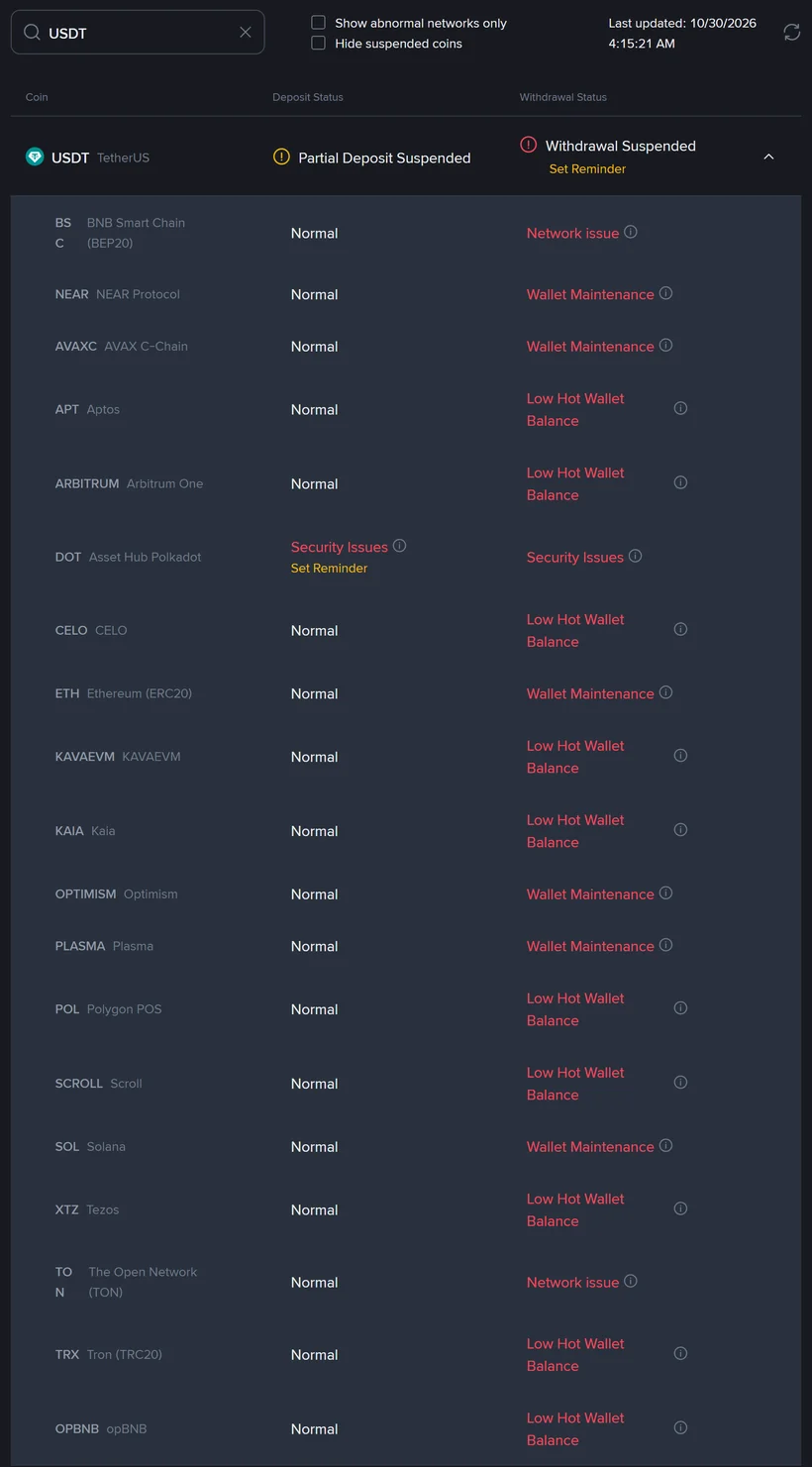
USDT carried the warning label "Partial Deposit Suspended", which reads alarmingly if you are about to send USDT in. Expanding the row shows what it actually refers to. USDT exists on 19 networks on Binance. Eighteen of them — including BNB Smart Chain, Ethereum, Tron, Solana, Polygon, Arbitrum and Optimism — showed deposits as Normal. One did not: Asset Hub Polkadot, flagged "Security Issues", with Binance's own note saying funds in transit "are safe once confirmed on the blockchain and will be credited shortly after deposits have resumed".
One more thing in that screenshot is worth noticing, because it is a trap. The reason shown next to each suspended withdrawal is an everyday label, not an incident label. Across all 1,447 closed withdrawal channels the labels break down as "Wallet Maintenance" on 476, "Low Hot Wallet Balance" on 444, "Unsupported Token" on 360 and "Network issue" on 31. These are the same words the page uses on an ordinary Tuesday. Do not read the cause of today's suspension off that column — read it off the announcement.
For a first deposit, today is a one-way door
The practical shape of this for a South African reader is simple. If you send USDT from VALR or Luno right now, it will almost certainly arrive: Tron, Ethereum and Solana deposits were all open at the time of writing. It just cannot leave again, and nobody has published a date for when it can.
That makes the normal decision about which network is cheapest to send USDT on beside the point today. The cheapest transfer into a balance you cannot withdraw is still worse than waiting. If you have already sent and nothing has appeared, the usual sequence of four checks for a crypto deposit that has not shown up still applies — the suspension changes the last check, not the first three.
What was still running at 13:10 SAST
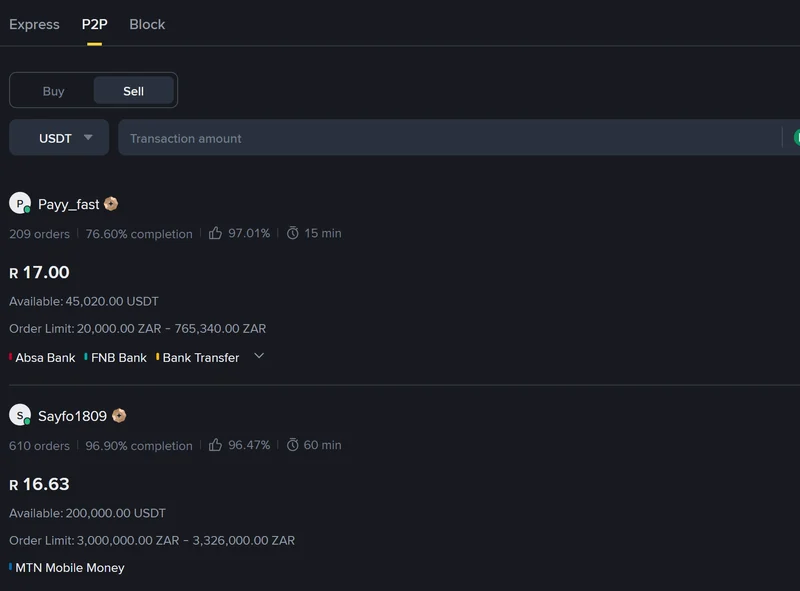
Both rand markets were open. The public P2P list returned 46 buy advertisements and 87 sell advertisements for USDT against the rand. On the default page view, the best sell advertisement was R17.00 from a merchant with 209 orders and a 76.60% completion rate, taking orders between R20,000 and R765,340; the next was R16.63. On the buy side, the cheapest advertisement accepting an ordinary bank transfer was R17.47, with a minimum of R150.
Binance's own USDT/ZAR spot book was also trading: last price R16.4254, with 481,531 USDT changing hands over 24 hours.
Neither of those moves a coin across a blockchain. A P2P trade and a spot trade are internal transfers between Binance accounts, which is why they are untouched by a suspension of on-chain deposits and withdrawals, and why the notice does not mention them. We cannot place an order without an account, so treat this as what the public order books showed, not as a promise that every order settles normally today.
The gap that the closed exit opened
Here is the part that costs real money, and it only shows up if you price the same coin in two places in the same minute.
| Market, 13:12 SAST | USDT in rand | Change over 24h |
|---|---|---|
| Binance USDT/ZAR spot | R16.4254 | −1.50% |
| VALR USDT/ZAR | R16.7003 | +0.23% |
| Luno USDT/ZAR | R16.7129 | — |
Binance's rand book was pricing USDT about 1.7% below the two local exchanges, and it had fallen 1.5% over the previous 24 hours while VALR drifted slightly up. That is what a closed exit does to a price: a coin you cannot take out is worth less inside than the same coin outside. Sell USDT on Binance's spot book today and you are paying that gap to get rand now.
The P2P buyers were quoting better than the spot book at that moment — R17.00 against R16.43 — which inverts the usual ranking in our comparison of the three routes from USDT back to rand. Before taking that at face value, check that the balance you want to sell is in the wallet the trade needs, because a P2P sale and a spot sale draw on different wallets.
This is not the hold that lands on one account
If your withdrawal was already blocked before this morning, this notice may not be your problem at all. Binance separately locks withdrawals on individual accounts for 24, 48 or 72 hours after a password change, a 2FA reset or a change to the withdrawal whitelist, and those account-level holds have their own messages and their own clocks. The quick way to tell them apart: an account hold shows you a countdown and names the trigger, while today's suspension shows the same "Withdrawal Suspended" status on the public status page for everyone, logged in or not.
Checking the status yourself, in about a minute
This is worth knowing beyond today, because individual networks go down for maintenance regularly.
- Open binance.com/en/network. It needs no login.
- Type your coin into the search box, then click the row to expand it. The networks appear underneath, each with its own deposit and withdrawal status.
- Tick "Show abnormal networks only" to see just the broken ones.
- "Set Reminder" on a suspended row asks Binance to notify you when it reopens, which beats refreshing the page.
- Read the timestamp carefully: "Last updated" renders in your device's clock, not in SAST, so a laptop set to another time zone will show a confusing hour.
For the event itself rather than the plumbing, the announcement page is the only source worth watching, together with Binance's own support channels. During a suspension, fake "recovery" accounts and fake support agents multiply, and the warning signs that separate a real process from a scam are the same ones that apply on a normal day: nobody legitimate asks you to move funds to a "safe wallet", and no official process happens in a WhatsApp group.
So what should you actually do
If you have not deposited yet, there is no reason to hurry today. A deposit made now buys you an asset you cannot move for an unknown number of days.
If your money is already in and you want rand, the P2P book was live and was quoting above the spot book; the spot book fills instantly, but at roughly the local market price minus 1.7%.
If you are not in a hurry at all, the cheapest option is the one nobody likes: wait for a resumption notice, check the status page for your own coin and network rather than for the exchange as a whole, and then move.
Sources
- Binance Announcements, Security Incident Update, published 30 October 2026 at 02:23 UTC (04:23 SAST), read the same day — every quoted sentence, the $6.3B and ~$3 billion figures, and the three precautionary measures. The page prints its publication time in your device's time zone.
- Binance Deposit & Withdrawal Status and the public coin-and-network data behind it, read 30 October 2026 at 13:10 SAST — the 1,447 closed withdrawal channels, the 398 closed deposit channels, the 19 USDT networks and the per-network reason labels.
- The public Binance P2P list for USDT against the rand, and the public USDT/ZAR spot market data, read 30 October 2026 at 13:11–13:12 SAST — advertisement counts, prices, order limits, the spot price and the 24-hour volume.
- Public market data from VALR and Luno, read 30 October 2026 at 13:12 SAST — the local USDT prices in the comparison table.
Prices and statuses here are single readings from one afternoon during an unfolding incident. Check the status page and the announcement before acting on any of it. This is general information, not financial advice.
If you are still deciding on an account
Nothing above is a reason to rush a sign-up either. If you do open an account later, how to confirm you are on the official domain and that a referral code has applied is worth reading first. Zovrino may receive a commission from an eligible referral, which changes none of the statuses, prices or limits described here.