Fees and Real Cost
Cashing Out USDT to Rand: Three Binance Routes Priced Side by Side
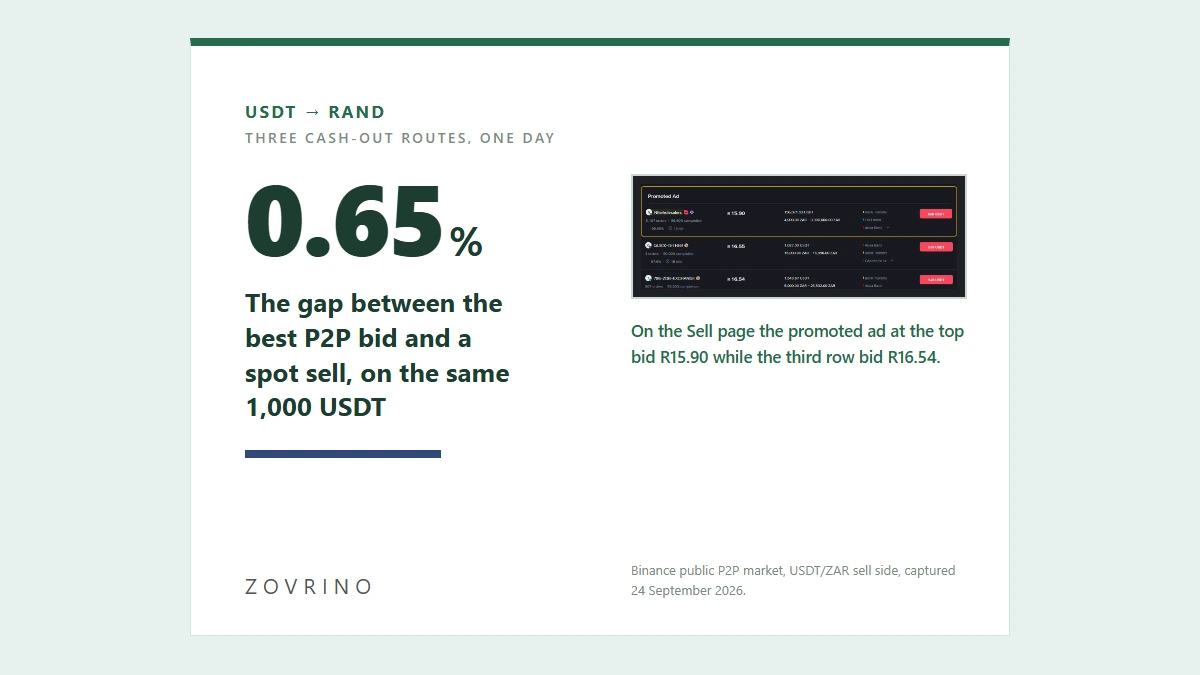
Turning USDT into rand in a South African bank account can go through Binance P2P, the USDT/ZAR spot book, or a transfer to VALR or Luno. All three were priced on the same 1,000 USDT on 24 September 2026, using public pages only: the best-rated P2P bid paid R106.65 more than a spot sale, the promoted advertisement at the top of the sell page paid 3.9% less than the row below it, and below about R5,000 the ranking flips.
You have USDT sitting on Binance and you want rand in a South African bank account. There is no single "withdraw to bank" button that covers it, and the three routes people actually use do not pay the same amount. On 24 September 2026 the gap between the best and the worst of them, on the same 1,000 USDT, was large enough to notice.
This article prices all three from public pages and public market data captured that afternoon. The rand figures will be stale by the time you read this. The method behind them will not be.
The three routes
- Sell on Binance P2P. A buyer takes your USDT out of escrow and sends rand to your bank by EFT.
- Sell on the USDT/ZAR spot market. Binance runs an order book priced in rand. You end up with a rand balance inside Binance, which still has to get to your bank.
- Send the USDT to a South African exchange. Withdraw on-chain to VALR or Luno, sell there, then use that platform's rand payout.
Route 1: selling on P2P
The public sell page does not need a login. Set the tab to Sell, the coin to USDT and the currency to ZAR, and you get the live list of people willing to buy from you, sorted by price.
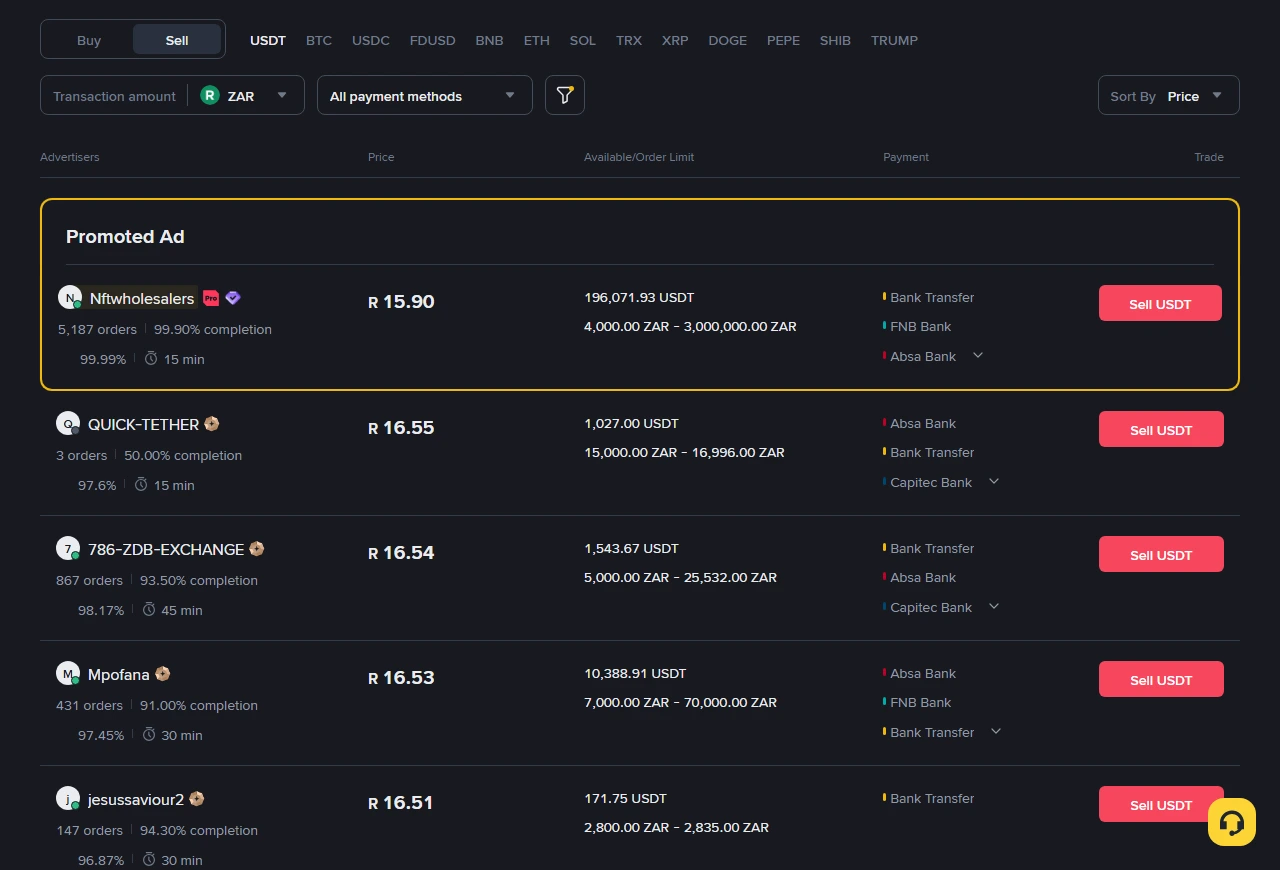 Binance public P2P market, Sell tab, USDT/ZAR, captured 24 September 2026. The boxed row at the top is a promoted advertisement.
Two things in that screenshot matter more than the prices themselves.
The first row is a promoted advertisement, and on this day it bid R15.90 while the third row down bid R16.54. That is 3.9% less for an identical trade, sitting at the top of the page above listings that pay more. The advertiser had 5,187 completed orders and a 99.90% completion rate, so this is not a scam signal — it is a paid placement, and the sort order does not protect you from it.
The second row shows the opposite problem. It bid the highest price on screen, R16.55, on the back of three completed orders and a 50.00% completion rate. Half of that advertiser's orders did not finish. A price you cannot collect is not a price. Reading those numbers properly is the same skill set out in how to vet an EFT merchant before you open an order.
Across the whole ZAR sell side that afternoon there were 118 live advertisements, 74 of them from merchants. The best bid from an advertiser with a real track record — 867 orders, 93.50% completion, a 45-minute payment window, order range R5,000 to R25,532 — was R16.54.
So 1,000 USDT sold that way is R16,540.00, paid into your bank by the buyer.
One number you cannot read from outside: your own P2P fee tier. Binance publishes P2P rates per currency and trade zone on its fee page, but the page states that the discount depends on your P2P user tier and shows your rate only after login. So check the rand total on the order screen before you confirm, rather than assuming the advertised price is exactly what you receive.
Route 2: selling on the USDT/ZAR order book
Binance also lists USDT against the rand as an ordinary spot pair, and it is not a dormant one. Over the previous 24 hours it had traded 512,939 USDT, about R8.41 million, across more than 8,000 trades.
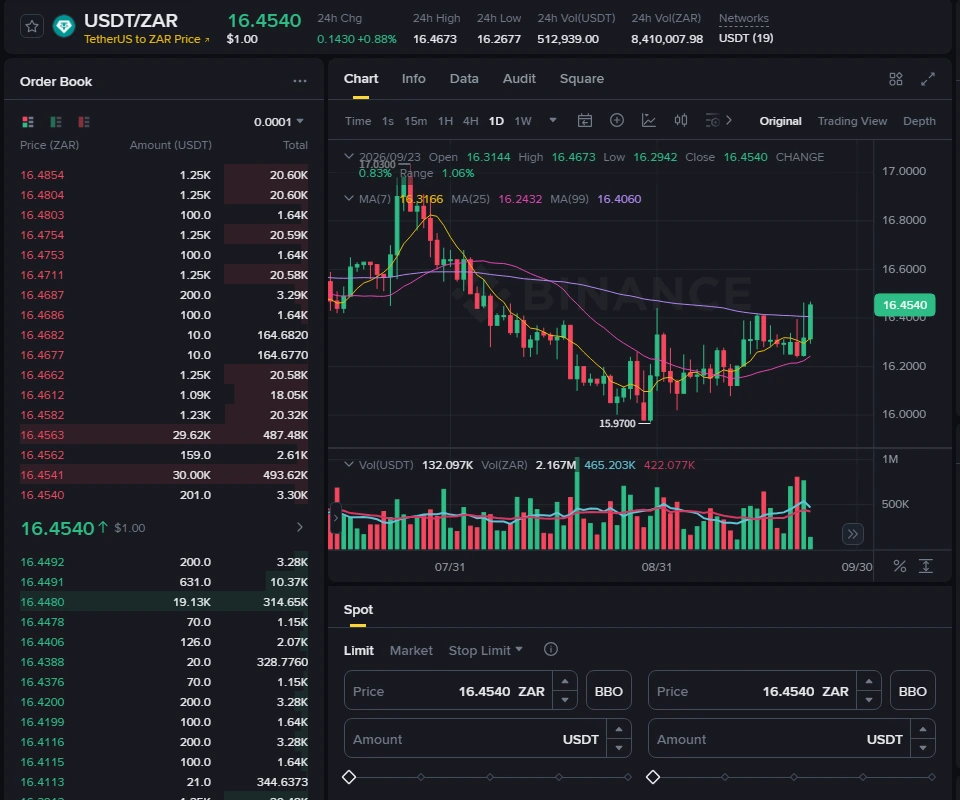 Binance USDT/ZAR spot page, public view without login, captured 24 September 2026. The green rows below the last price are the bids you would sell into.
The book is deeper than the screenshot suggests. Adding up the top 50 bid levels gave 196,104 USDT of standing demand. Selling 1,000 USDT into it at market would have averaged R16.4498, one-thousandth of a percent below the top bid; even 20,000 USDT would have averaged R16.4488. Slippage is not what costs you money here.
The trading fee is. At the standard tier Binance charges 0.100% on spot taker orders, so:
- 1,000 USDT filled at an average of 16.4498 → R16,449.80
- less the 0.1% taker fee → R16,433.35
Three mechanical limits apply to this pair and are easy to trip over. Order size steps in whole USDT, so you cannot sell 1,000.37 USDT — the fraction stays behind. The minimum order value is R100. Market orders were capped at 15,671 USDT per order at the time of capture.
And then the rand is still inside Binance. Whether your account can move that balance to a South African bank, and what that costs, only appears once you are logged in. Treat the withdrawal screen as the source of truth, in the same way the deposit screen is for the routes and minimums for getting rand into Binance.
Route 3: sending the USDT to a local exchange
This route adds a blockchain transfer before you sell, so the first thing to check is which networks the receiving platform accepts — not which network is cheapest on Binance.
VALR's public currency list that day accepted USDT deposits on three networks only: Tron, Ethereum and Solana. Binance's cheapest USDT withdrawal, BNB Smart Chain at 0.01 USDT, is not on that list. Of the networks VALR does accept, Binance charged 0.3 USDT on Ethereum, 0.3 on Solana and 1.5 on Tron. Picking Tron out of habit costs five times what Solana does — the same trap, in the opposite direction, as choosing a network when you move USDT from a local exchange to Binance.
Withdraw 1,000 USDT on Solana, pay 0.3 USDT, and 999.7 USDT arrives. At VALR's bid of 16.4618 that is R16,456.86 before VALR's own costs. Luno's bid was 16.4678, so about R16,462.86.
Both are gross figures. Two numbers still have to come off, and neither is on a public page: the platform's trading fee on the sale, and its rand withdrawal fee. Look up both on the platform's own fee schedule before you commit, because they decide whether this route beats the other two.
The three routes side by side
For 1,000 USDT, on the afternoon of 24 September 2026:
| Route | What 1,000 USDT became | Where the rand lands |
|---|---|---|
| P2P sale at R16.54 | R16,540.00, no fee shown in the price | your bank, by EFT from the buyer |
| Spot sale at 16.4498 average | R16,449.80 less the 0.1% taker fee, so R16,433.35 | a rand balance inside Binance |
| Solana transfer, sold on VALR at 16.4618 | R16,456.86 after the 0.3 USDT network fee, before VALR's own charges | your bank, once VALR pays out |
The P2P sale paid R106.65 more than the spot sale, or 0.65% — and it landed in a bank account rather than in a balance that still needs moving. That is the opposite of what most people expect, because P2P has a reputation for being the expensive option.
It is the expensive option in the other direction. On the same afternoon, buying USDT with rand on P2P in a R1,000 order meant paying about 17.09 against a spot offer of 16.4507, a premium of roughly 3.9%. Selling is where P2P advertisers compete for your business; buying is where they price the convenience.
Your amount changes the answer
The P2P price is not one price. It depends on how much you are selling, because advertisers set their own order ranges.
Typing R1,000 into the transaction box that day left only merchants who accept small orders, and the best of those bid R16.39 — about 0.36% below the spot bid. Typing R5,000 brought the R16.54 advertisement back into range. The advantage shown above appears somewhere around R5,000 and disappears beneath it.
If you cash out a few hundred rand at a time, do not assume the comparison holds. Run it for your own amount.
Redoing this check in five minutes
- Open the P2P Sell page for USDT/ZAR, type your actual amount into the transaction box, and read the price the list returns. Skip the promoted row. Ignore any advertiser whose completion rate is not close to 100%.
- Open the USDT/ZAR spot page and read the top bid, not the last traded price. Subtract 0.1%.
- If a local exchange is in the running, check which networks it accepts for USDT deposits, then look up its trading fee and its rand withdrawal fee.
- Compare the three rand totals, not the three prices.
The gap between routes on this day was about half a percent on a R16,000 cash-out — larger than every fee in the process combined, and it took four minutes to find.
Figures here are a snapshot taken on 24 September 2026 from Binance's public P2P market, its public USDT/ZAR trading page and fee schedule, VALR's public currency and market data, and Luno's public ticker. Prices, advertisements and fees all change.