Eligibility and Referral
Is Binance Licensed in South Africa? How to Check the FSCA Register Yourself
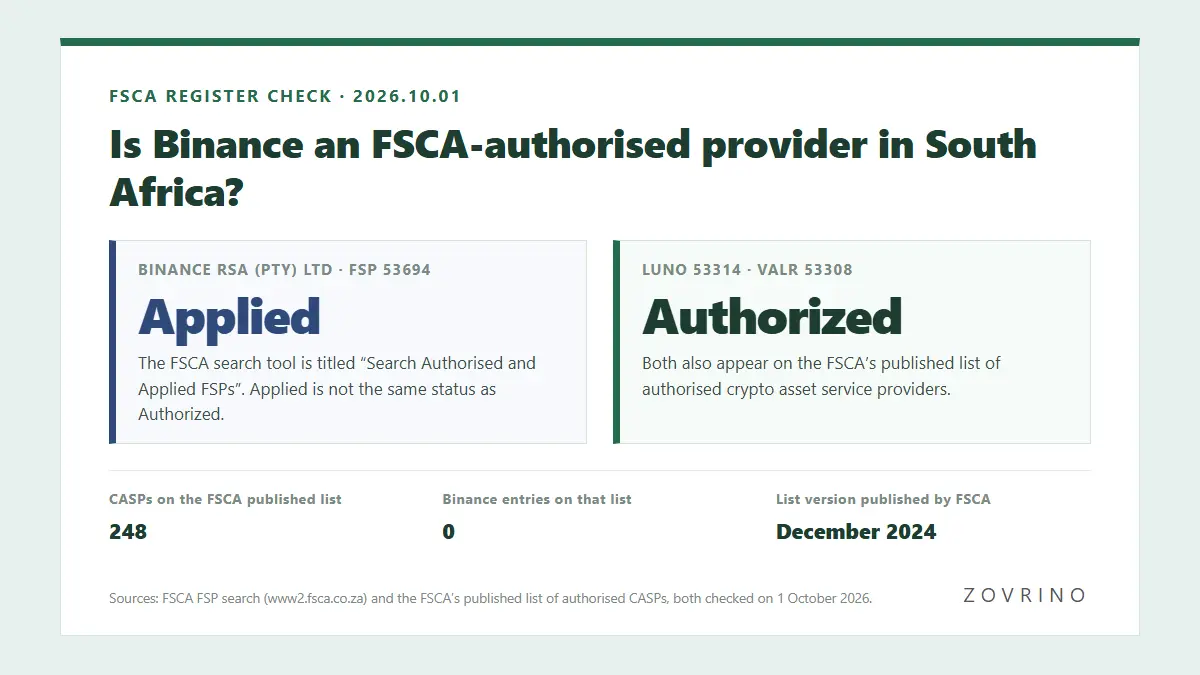
On 1 October 2026 the FSCA's own register shows BINANCE RSA (PTY) LTD with the status Applied, while Luno and VALR show Authorized. Two public checks take about five minutes each, and the difference decides which complaints route is open to you.
Before your first rand leaves your bank account, there is a question worth five minutes: is the platform you are about to fund actually on South Africa's financial register, and what happens if something goes wrong?
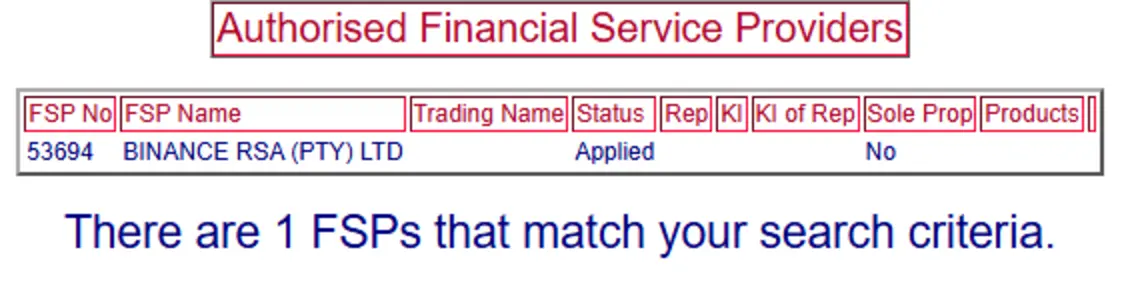
For Binance the answer is more specific than "yes" or "no". On 1 October 2026 the Financial Sector Conduct Authority's own search tool returns one matching company — BINANCE RSA (PTY) LTD, FSP number 53694 — and its status field reads Applied, not Authorized. Luno and VALR, the two local exchanges most South Africans compare Binance against, both come back as Authorized.
Here is how to run both checks yourself, what the result does and does not tell you, and why the difference matters for a first deposit.
What the FSCA actually licenses
The FSCA lists "crypto asset service providers" among the institutions it regulates, alongside banks, insurers and ordinary financial advisers. Authorisation happens under the Financial Advisory and Intermediary Services Act 37 of 2002 — the FAIS Act. The authority's published list is titled, in full, "List of crypto asset service providers (CASPs) authorised under the Financial Advisory and Intermediary Services (FAIS) Act, No. 37 of 2002".
That wording matters. A FAIS licence covers advice and intermediary services around a financial product. It is not a guarantee that a platform is solvent, well run, or that your coins are safe. What it does give you is a regulator with a named licence holder on file, and a complaints route that only exists for licensed providers.
Check 1: the FSP search, in about a minute
The FSCA's live register is reachable from the footer of fsca.co.za as "FSP Search". The page itself is titled "Search Authorised and Applied FSPs" — that phrasing is the single most useful thing on it, because it tells you upfront that appearing in the results is not the same as being authorised.
- Open the FSP search page at www2.fsca.co.za/Fais/Search_FSP.htm.
- Leave the FSP number blank and type a partial name into Search For FSP Name — "BINANCE", "LUNO", "VALR".
- Press Submit and read the Status column, not just the fact that a row came back.
Searching BINANCE on 1 October 2026 returns exactly one company:
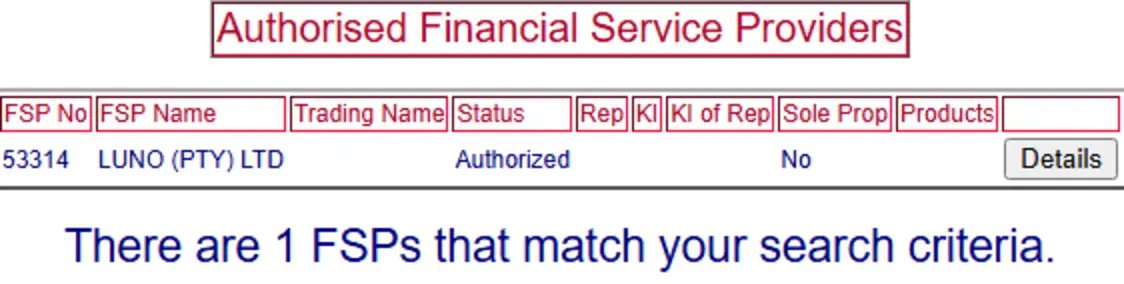
Run the same search for LUNO and the Status column reads differently:
Searching VALR returns two rows — VALR (PTY) LTD on FSP 53308 and VALR DAM PTY LTD on FSP 54897 — both Authorized. That is a reminder to read the exact company name, not just the brand you recognise.
Check 2: the published list of authorised CASPs
The FSCA also publishes a standalone PDF list of authorised crypto asset service providers, linked straight from the carousel on the fsca.co.za homepage ("Approved list of crypto asset service providers"). The version live on 1 October 2026 is dated December 2024 and runs to 36 pages and 248 numbered entries, from ABSOLUT ASSET MANAGEMENT at number 1 to ZITENGA SA at number 248.
It is alphabetical, which makes the absence easy to verify rather than take on trust. Entries 24 and 25 are BETA CAPITAL and BIOCERTICA — exactly where a company called Binance would sit:
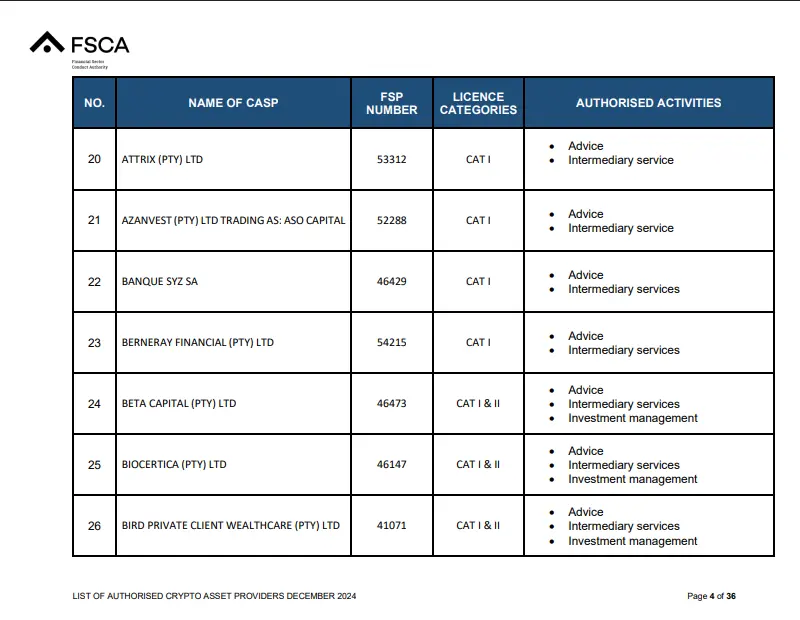
Luno appears at number 136 and VALR at number 229, with the same FSP numbers the live register shows. The list also gives each provider's licence categories and authorised activities, which is worth a glance: "Advice", "Intermediary services" and "Investment management" are different permissions.
What we found, side by side
| Entity as it appears on the register | Status in the FSP register (1 Oct 2026) | On the December 2024 CASP list |
|---|---|---|
| BINANCE RSA (PTY) LTD — FSP 53694 | Applied | No |
| LUNO (PTY) LTD — FSP 53314 | Authorized | Yes, number 136 |
| VALR (PTY) LTD — FSP 53308 | Authorized | Yes, number 229 |
Two caveats on that table. The published PDF is nearly two years old, so a provider authorised during 2025 or 2026 would show as Authorized in the live register while still being absent from the list — the register is the fresher source. And a status can change between the day this was written and the day you read it, which is exactly why the steps above matter more than the snapshot.
What "Applied" tells you, and what it does not
The register records that an application exists. It does not say when it was lodged, how far it has progressed, or what the outcome will be, and the FSCA does not publish that detail in the search results. Anyone telling you confidently what happens next is guessing.
It also does not mean you are breaking any law by holding an account, and it does not mean the platform is about to disappear. South Africans use Binance daily — our own walk-through of the ZAR funding routes exists because the rails work.
What it does change is where you stand if a transaction goes wrong.
Why this matters at the moment of a dispute
The Office of the Ombud for Financial Services Providers — the FAIS Ombud — was set up under the same FAIS Act. Its mandate page is explicit about scope: it "deals with complaints submitted to the Office by a specific client against a financial services provider", and the complaint "must relate to a financial service rendered by a financial services provider or the representative of the provider". Its determinations, the office notes, have the effect of a civil judgment of a court.
Two practical conditions are attached. You must first try to resolve the complaint with the provider, who gets six weeks. After their final response you have six months to take it to the Ombud.
Read those two sentences together with the register result. For an authorised provider such as Luno or VALR, that route is on the table once you have exhausted the provider's own process. For a company whose status reads Applied, the picture is far less clear, and your realistic first and second line of recourse is the platform's internal process — which, on Binance, means the in-app appeal flow. If you trade peer-to-peer, our guide to appealing a P2P order where the seller has not released your USDT sets out the official timelines you actually get.
That asymmetry is the real decision point, not the word on the screen.
A sensible way to use this before your first deposit
- Run the search yourself, by name, on the day. It takes under a minute, and it is the only version of this answer that is current.
- Split the question. "Is the platform regulated here?" and "is the platform the cheapest route?" have different answers, and you are allowed to use the regulated one for the parts that matter most to you.
- Watch the hop, not just the venue. A common pattern is to buy on an FSCA-authorised local exchange and move the coin to Binance to trade. If that is your plan, the cost sits in the network you pick — we priced the Luno and VALR transfer routes into Binance and the gap between the cheapest and most expensive chain is larger than most people expect.
- Keep your own paper trail. Order IDs, transaction IDs, bank references and timestamps are what any complaints process — internal or regulatory — asks for first.
Sources and dates
- FSCA FSP Search — searches for BINANCE, LUNO and VALR, run 1 October 2026. Page title: "Search Authorised and Applied FSPs".
- FSCA: list of crypto asset service providers authorised under the FAIS Act, December 2024 (PDF, 36 pages, 248 entries; linked from the fsca.co.za homepage, downloaded 1 October 2026).
- FSCA: Regulated Entities — the authority's own description of the institutions it regulates, read 1 October 2026.
- FAIS Ombud: Mandate and the FAIS Ombud homepage — scope of complaints and the six-week and six-month windows, read 1 October 2026.
Register entries and published lists change without notice. Everything above is a reading taken on one day; re-run the two checks before you act on them. This is general information about public registers, not legal or financial advice.
If you have not registered yet
Read the Binance referral-code guide first. It explains how to verify the official domain, the code CG17CR7R and the advertised benefit of up to 20% in trading-fee rebates. Eligibility, products and the final rate depend on the registration page and account terms; Zovrino may receive a commission from an eligible referral. A referral link changes nothing about the register status described above.
The code we use is CG17CR7R (link). Typing binance.com yourself gives you the same account.